Top 10 Commonly Confused Words in Amphibian Conservation

Introduction

Welcome to today’s lesson on amphibian conservation. In this lesson, we’ll be discussing the top 10 commonly confused words in this field. Let’s dive in!

1. Endangered vs. Threatened

One of the most common confusions in conservation is between the terms ‘endangered’ and ‘threatened.’ While both indicate a species at risk, ‘endangered’ means it’s at a higher risk of extinction, while ‘threatened’ means it’s at a lower risk but still in danger.
2. Habitat vs. Ecosystem

Another pair of words that often causes confusion is ‘habitat’ and ‘ecosystem.’ A ‘habitat’ refers to the specific place where a species lives, while an ‘ecosystem’ is a more comprehensive term, encompassing the interactions between living and non-living elements in that area.

3. Invasive vs. Non-native

When discussing species, ‘invasive’ and ‘non-native’ are two terms that are sometimes used interchangeably. However, there’s a distinction. A ‘non-native’ species is one that’s not naturally found in an area, while an ‘invasive’ species is not only non-native but also has a negative impact on the local ecosystem.

4. Biodiversity vs. Species Richness

While ‘biodiversity’ and ‘species richness’ are related, they’re not the same. ‘Biodiversity’ encompasses the variety of life forms in an ecosystem, including genetic and ecological diversity, while ‘species richness’ focuses solely on the number of different species present.

5. Extinction vs. Extirpation

When a species is no longer found in a specific area but still exists elsewhere, it’s considered ‘extirpated.’ ‘Extinction,’ on the other hand, means the complete loss of a species from the entire planet. So, ‘extirpation’ is a more localized form of extinction.

6. Keystone Species vs. Indicator Species

Both ‘keystone species’ and ‘indicator species’ play important roles in an ecosystem, but in different ways. A ‘keystone species’ has a disproportionate impact on its environment, while an ‘indicator species’ serves as a sign of the overall health of an ecosystem.

7. Conservation vs. Preservation

While both terms relate to protecting the environment, ‘conservation’ and ‘preservation’ have different approaches. ‘Conservation’ focuses on sustainable use of natural resources, while ‘preservation’ emphasizes safeguarding nature in its pristine state, often with minimal human intervention.
8. Poaching vs. Illegal Wildlife Trade

Although ‘poaching’ and ‘illegal wildlife trade’ involve the illegal hunting or capture of animals, ‘illegal wildlife trade’ has a broader scope. It includes not just the act of killing or capturing, but also the subsequent buying, selling, and transportation of wildlife products.

9. Reintroduction vs. Introduction

When a species is brought back to an area where it was once extinct, it’s a ‘reintroduction.’ ‘Introduction,’ on the other hand, refers to the deliberate release of a species into an area where it didn’t previously exist.

10. Mitigation vs. Adaptation

In the context of climate change, ‘mitigation’ refers to actions taken to reduce greenhouse gas emissions and limit its impact, while ‘adaptation’ involves adjusting to the changes that are already occurring or expected in the future.
Top 10 Commonly Confused Words in Amphibian Biology

Introduction: The Importance of Precise Terminology

As you delve deeper into the fascinating world of amphibian biology, you’ll encounter numerous terms that might seem similar but have distinct meanings. In this lesson, we’ll explore the top 10 commonly confused words in this field. Understanding these terms accurately is crucial for your studies and future research. So, let’s get started!

1. Amphibian vs. Reptile

While both amphibians and reptiles are ectothermic vertebrates, they differ in several ways. Amphibians typically have moist, permeable skin, whereas reptiles have dry, scaly skin. Additionally, amphibians undergo metamorphosis, while reptiles do not. So, the next time you spot a creature, consider its skin type and life cycle to determine if it’s an amphibian or a reptile.

2. Tadpole vs. Polliwog

These terms both refer to the larval stage of amphibians, but their usage varies geographically. Tadpole is the more commonly used term, while polliwog is often used in British English. Regardless of the term, it describes the aquatic, gill-breathing stage before metamorphosis into an adult amphibian.

3. Toad vs. Frog

Toads and frogs are both amphibians, but they have distinct characteristics. Toads usually have drier, bumpier skin and are adapted to terrestrial habitats. Frogs, on the other hand, have smoother skin and are more aquatic. So, if you encounter a small, moist creature near a pond, it’s likely a frog, while a dry, bumpy one might be a toad.

4. Hibernation vs. Estivation

These terms describe periods of inactivity in amphibians, but they occur during different seasons. Hibernation is a winter dormancy, while estivation is a summer dormancy. During these periods, amphibians conserve energy and reduce their metabolic rate to survive harsh environmental conditions.

5. Ectothermic vs. Endothermic

Amphibians, like all reptiles, are ectothermic, which means their body temperature fluctuates with the environment. In contrast, mammals, including humans, are endothermic, maintaining a relatively constant internal body temperature. This difference in temperature regulation has significant implications for amphibian behavior and habitat selection.

6. Metamorphosis vs. Ontogeny

Metamorphosis refers specifically to the transformation of an amphibian from its larval stage, such as a tadpole, to its adult form. Ontogeny, on the other hand, is a broader term encompassing all the developmental changes an organism undergoes throughout its life, including growth, maturation, and aging.

7. Ecosystem vs. Habitat

While these terms are related to the environment an organism lives in, they have different meanings. A habitat refers to the specific place or physical location where an organism resides. An ecosystem, on the other hand, is a more comprehensive concept, encompassing not just the physical environment but also the interactions between organisms and their surroundings.

8. Nocturnal vs. Diurnal

These terms describe the activity patterns of organisms. Nocturnal species are active during the night, while diurnal species are active during the day. Many amphibians, such as certain frog species, are nocturnal, using the cover of darkness to hunt and avoid predators.

9. Herbivore vs. Carnivore

These terms describe an organism’s dietary preferences. Herbivores primarily consume plant matter, while carnivores feed on other animals. While most amphibians are carnivorous, some, like certain frog species, have a more varied diet, including insects and small invertebrates.

10. Biodiversity vs. Species Richness

Both these terms relate to the variety of life forms in a particular area, but they have different nuances. Biodiversity encompasses not just the number of species but also their genetic diversity and the variety of ecosystems they inhabit. Species richness, on the other hand, refers specifically to the number of different species present in a given area.

Top 10 Commonly Confused Words in Alpine Ecology

Introduction

Welcome to today’s lesson on alpine ecology. In this lesson, we’ll be focusing on a topic that often trips up students – commonly confused words. Understanding these words is crucial for a comprehensive grasp of the subject. So, let’s dive in!

1. Endemic vs. Indigenous

The first pair of words that often causes confusion is ‘endemic’ and ‘indigenous.’ While both refer to species native to a particular region, there’s a subtle difference. ‘Endemic’ species are exclusively found in that region, whereas ‘indigenous’ species can be found in other places too, although they are native to the region in question.

2. Glacier vs. Icefield

Next up, we have ‘glacier’ and ‘icefield.’ These terms are often used interchangeably, but they have distinct meanings. A ‘glacier’ is a large mass of ice that moves slowly, while an ‘icefield’ is a vast expanse of interconnected ice, often covering a mountain range.

3. Moraine vs. Till

Moving on, let’s clarify the difference between ‘moraine’ and ’till.’ Both are types of sediment, but they form in different ways. ‘Moraine’ refers to the accumulation of debris by a glacier, while ’till’ is the unsorted material left behind by a glacier’s retreat.

4. Cirque vs. Arete

Now, let’s talk about ‘cirque’ and ‘arete.’ These are landforms commonly found in alpine regions. A ‘cirque’ is a bowl-shaped depression formed by a glacier, while an ‘arete’ is a sharp ridge that separates two cirques.

5. Scree vs. Talus

The next pair, ‘scree’ and ‘talus,’ both refer to loose rock debris. However, ‘scree’ specifically denotes the small, angular rocks found at the base of a slope, while ‘talus’ refers to a larger accumulation of rocks.

6. Alpine vs. Subalpine

Let’s now discuss the difference between ‘alpine’ and ‘subalpine.’ These terms are used to describe different vegetation zones. ‘Alpine’ refers to the high-altitude zone above the treeline, while ‘subalpine’ is the zone just below it.

7. Snowfield vs. Snowpatch

Moving on, we have ‘snowfield’ and ‘snowpatch.’ While both refer to areas of snow, there’s a difference in their persistence. A ‘snowfield’ is a more permanent feature, often persisting throughout the year, whereas a ‘snowpatch’ is a smaller, temporary accumulation.

8. Fellfield vs. Tundra

Now, let’s differentiate between ‘fellfield’ and ‘tundra.’ These terms describe vegetation types. ‘Fellfield’ refers to the sparse, low-growing vegetation found in rocky alpine areas, while ‘tundra’ is a broader term encompassing the treeless, low-temperature ecosystems of the Arctic and high mountains.

9. Solifluction vs. Frost Heave

The next pair, ‘solifluction’ and ‘frost heave,’ both pertain to soil movement. ‘Solifluction’ is the slow, downhill movement of waterlogged soil, often observed in areas with permafrost. ‘Frost heave,’ on the other hand, is the upward movement of soil due to the expansion of freezing water within it.

10. Nivation vs. Ablation

Lastly, let’s clarify ‘nivation’ and ‘ablation.’ These terms relate to the processes of snow accumulation and loss. ‘Nivation’ encompasses all the processes involved in snow accumulation, while ‘ablation’ refers to the loss of snow through melting, sublimation, or other means.

Top 10 Commonly Confused Words in Algorithmic Trading

Introduction

Algorithmic trading is a fascinating field, but it comes with its fair share of jargon. Today, we’ll be discussing the top 10 words that often cause confusion. Let’s dive in!

1. Strategy vs. Tactic

While these terms are related, they have distinct meanings. A strategy is a broad plan, outlining your overall approach. On the other hand, a tactic refers to the specific actions you take within that strategy. Think of strategy as the ‘what’ and tactic as the ‘how’.

2. Backtesting vs. Forward Testing

Both are crucial steps in developing a trading system, but they occur at different stages. Backtesting involves analyzing historical data to assess how a strategy would have performed. Forward testing, on the other hand, involves running the strategy in real-time with simulated trades. It’s like a trial run before going live.

3. Limit Order vs. Market Order

When placing an order, you have two primary options. A limit order allows you to set a specific price at which you’re willing to buy or sell. A market order, on the other hand, executes the trade at the best available price in the market. Market orders offer speed, while limit orders provide control over the price.

4. Alpha vs. Beta

These terms are often used in the context of risk and return. Alpha measures the excess return of an investment compared to a benchmark. It’s a way to assess the skill of a trader or portfolio manager. Beta, on the other hand, measures the volatility of an investment in relation to the overall market. It’s a measure of systematic risk.

5. Slippage vs. Latency

In the world of high-frequency trading, speed is crucial. Slippage refers to the difference between the expected price of a trade and the actual executed price. It can occur due to market volatility or insufficient liquidity. Latency, on the other hand, is the delay between an event occurring and the system’s response. Even milliseconds matter in this realm.

6. Arbitrage vs. Speculation

While both involve making trades to profit, they differ in their approach. Arbitrage is about exploiting price discrepancies in different markets or instruments to make risk-free profits. Speculation, on the other hand, involves taking calculated risks based on market analysis, with the aim of making a profit.

7. Long vs. Short

These terms refer to the direction of a trade. Going long means buying an asset with the expectation that its price will rise. Going short, on the other hand, involves selling an asset with the expectation that its price will fall. Both strategies can be profitable, depending on market conditions.

8. Volatility vs. Volume

In the world of trading, these terms are often used, but they have different meanings. Volatility refers to the degree of price fluctuation. High volatility can present opportunities but also risks. Volume, on the other hand, refers to the number of shares or contracts traded. It’s an indicator of market liquidity and interest.

9. Stop Loss vs. Take Profit

These are risk management tools. A stop loss order is placed to limit potential losses. It automatically triggers a sell order if the price reaches a certain level. Take profit, on the other hand, is an order to close a position when a certain profit level is reached. Both are essential for disciplined trading.

10. Algorithm vs. Model

In algorithmic trading, these terms are often used interchangeably, but they have distinct meanings. An algorithm is a set of rules or instructions that dictate the trading decisions. A model, on the other hand, is a mathematical or statistical representation of the market. It’s the foundation on which the algorithm is built.

Top 10 Commonly Confused Words in Agronomy and Crop Science

Introduction

Welcome to today’s lesson on commonly confused words in agronomy and crop science. Understanding these terms is crucial for a successful career in this field. So, let’s dive in!

1. Annual vs. Perennial

Often, students get confused between annual and perennial crops. Annual crops complete their life cycle in a year, while perennial crops live for multiple years. Examples of annual crops include corn and wheat, while apple trees are a classic example of a perennial crop.

2. Fertilizer vs. Pesticide

While both fertilizer and pesticide are used in agriculture, they serve different purposes. Fertilizers provide essential nutrients to plants, promoting growth. On the other hand, pesticides are used to control pests and diseases that can harm crops.

3. Genotype vs. Phenotype

Genotype refers to the genetic makeup of an organism, while phenotype is the observable physical or biochemical characteristics. In crop science, understanding the genotype-phenotype relationship is crucial for breeding programs and crop improvement.

4. Organic vs. Inorganic

Organic and inorganic, in the context of agriculture, refer to the source of nutrients. Organic fertilizers are derived from natural sources, such as compost or manure, while inorganic fertilizers are synthetically produced. Each has its advantages and considerations.

5. Tillage vs. No-Till

Tillage involves the mechanical manipulation of soil, such as plowing, to prepare it for planting. No-till, as the name suggests, involves minimal disturbance of the soil. Both methods have their benefits, and the choice depends on various factors, including soil health and erosion control.

6. Hybrid vs. Heirloom

Hybrid and heirloom are terms used to describe plant varieties. Hybrids are the result of crossbreeding between different parent plants, often with desirable traits. Heirloom varieties, on the other hand, are older, open-pollinated varieties that have been passed down through generations.

7. Monoculture vs. Polyculture

Monoculture refers to the cultivation of a single crop in a given area, while polyculture involves growing multiple crops together. Each approach has its advantages and challenges, such as pest management and soil fertility.

8. Germination vs. Emergence

Germination is the process by which a seed sprouts and begins to grow. Emergence, on the other hand, refers to the point when the seedling breaks through the soil surface. Understanding these terms is essential when studying crop establishment and stand counts.

9. Macronutrients vs. Micronutrients

Plants require various nutrients for their growth and development. Macronutrients, such as nitrogen, phosphorus, and potassium, are needed in larger quantities. Micronutrients, like iron and zinc, are required in smaller amounts but are equally important.

10. Photosynthesis vs. Respiration

Photosynthesis is the process by which plants convert light energy into chemical energy, while respiration is the process of releasing that energy for plant growth and metabolism. These fundamental processes are the basis of plant productivity.

Top 10 Commonly Confused Words in Agrometeorology

Introduction

Welcome to today’s agrometeorology class. In this session, we will be discussing the top 10 commonly confused words in agrometeorology. Understanding these words correctly is crucial for a successful career in this field. So, let’s dive in!

1. Weather vs. Climate

The first pair of words that often causes confusion is ‘weather’ and ‘climate.’ While weather refers to the atmospheric conditions at a specific time and place, climate represents the long-term patterns and averages of weather in a particular region. So, weather is like the current mood of the atmosphere, while climate is its overall personality.

2. Evaporation vs. Transpiration

The terms ‘evaporation’ and ‘transpiration’ are often used interchangeably, but they have distinct meanings. Evaporation is the process by which water changes from a liquid to a gas, primarily from the Earth’s surface. On the other hand, transpiration is the release of water vapor from plants into the atmosphere. So, while evaporation is more about water bodies, transpiration is about plants.

3. Forecast vs. Prediction

Many people think ‘forecast’ and ‘prediction’ mean the same thing, but in agrometeorology, they have different connotations. A forecast is a more specific and detailed statement about future weather conditions, often backed by scientific models. On the other hand, a prediction is a more general statement about what might happen, often based on experience or intuition.

4. Rainfall vs. Precipitation

While ‘rainfall’ specifically refers to the amount of rain that falls from the atmosphere to the ground, ‘precipitation’ is a broader term. Precipitation includes all forms of water, both liquid and solid, that fall from the atmosphere, such as rain, snow, sleet, or hail. So, rainfall is a subset of precipitation.

5. Drought vs. Aridity

Although both ‘drought’ and ‘aridity’ imply a lack of water, they differ in their scope. A drought is a temporary period of below-average precipitation, leading to water scarcity. Aridity, on the other hand, is a long-term characteristic of a region, indicating its natural dryness. So, while a drought can be alleviated, aridity is a more permanent feature.

6. Anemometer vs. Wind Vane

When it comes to measuring wind, two common instruments are the anemometer and the wind vane. An anemometer measures the speed of the wind, while a wind vane indicates its direction. So, if you want to know how fast the wind is blowing, use an anemometer. But if you’re interested in its direction, a wind vane is the right tool.

7. Humidity vs. Relative Humidity

Humidity refers to the amount of moisture present in the air. Relative humidity, on the other hand, is a measure of how much moisture the air is holding compared to the maximum it can hold at a given temperature. So, while humidity is an absolute measure, relative humidity is expressed as a percentage, indicating the air’s saturation level.

8. Frost vs. Freeze

Although both ‘frost’ and ‘freeze’ involve the formation of ice, they occur under different conditions. Frost typically forms on surfaces, such as the ground or plants, when the temperature drops below freezing point and the moisture in the air condenses directly into ice. Freezing, on the other hand, refers to the temperature itself, indicating that it has dropped below the freezing point of water.

9. Front vs. Frontal System

In agrometeorology, ‘front’ and ‘frontal system’ are often used interchangeably, but they have slightly different meanings. A front is a boundary between two air masses with different characteristics, such as temperature or humidity. A frontal system, on the other hand, refers to the entire weather system associated with a front, including the clouds, precipitation, and other atmospheric phenomena.

10. Monsoon vs. Monsoon Season

The term ‘monsoon’ is often used to describe a seasonal wind system that brings significant rainfall. However, ‘monsoon season’ specifically refers to the period when these winds are active and result in heavy precipitation. So, while the monsoon is the wind, the monsoon season is the time when it brings the much-needed rain.

Top 10 Commonly Confused Words in Agroforestry

Introduction to Agroforestry

Agroforestry is a fascinating field that combines agriculture and forestry. However, it’s not uncommon to come across words that may seem similar but have distinct meanings. In this lesson, we’ll explore the top 10 commonly confused words in agroforestry, helping you avoid any confusion in your studies.

1. Silviculture vs. Agroforestry

Silviculture and agroforestry are often used interchangeably, but they have different focuses. Silviculture primarily deals with the cultivation and management of forests for timber production, while agroforestry encompasses the intentional integration of trees with crops or livestock. So, while both involve trees, their objectives and approaches differ.

2. Shelterbelt vs. Windbreak

Shelterbelts and windbreaks serve similar purposes of protecting fields from wind erosion and providing microclimatic benefits. However, shelterbelts are typically composed of multiple rows of trees and shrubs, offering a more comprehensive barrier. Windbreaks, on the other hand, are single rows of trees, often used to shield specific areas like farmsteads or livestock pens.

3. Alley Cropping vs. Strip Cropping

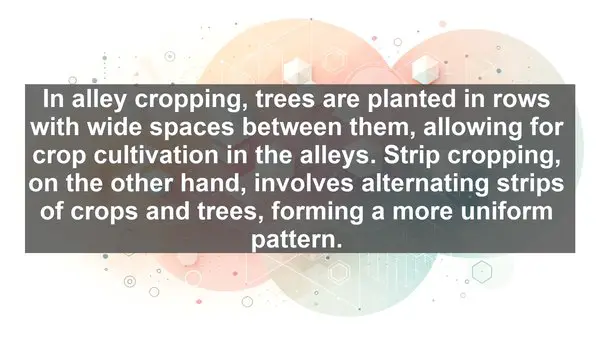
Alley cropping and strip cropping are both agroforestry practices that involve growing crops alongside trees. However, the key difference lies in their arrangement. In alley cropping, trees are planted in rows with wide spaces between them, allowing for crop cultivation in the alleys. Strip cropping, on the other hand, involves alternating strips of crops and trees, forming a more uniform pattern.

4. Biomass vs. Litter

Biomass and litter are terms often encountered when discussing organic matter in agroforestry. Biomass refers to the total mass of living or recently living organisms, including trees, crops, and their residues. Litter, on the other hand, specifically refers to the dead plant material, such as fallen leaves or twigs, on the forest floor.

5. Coppicing vs. Pollarding

Coppicing and pollarding are methods of tree pruning that promote regrowth. In coppicing, the tree is cut down to the base, resulting in multiple shoots emerging from the stump. Pollarding, on the other hand, involves removing the upper branches, encouraging the growth of new branches from the main trunk. Both methods have historical and practical significance in agroforestry.

6. Nurse Crop vs. Cover Crop

Nurse crops and cover crops are both used in agroforestry to provide temporary vegetation. However, their purposes differ. A nurse crop is typically a fast-growing crop, such as corn or beans, planted alongside tree seedlings to provide initial shade and protection. A cover crop, on the other hand, is primarily used for soil improvement, erosion control, or weed suppression.

7. Mast vs. Browse

Mast and browse are terms related to animal forage in agroforestry. Mast refers to the fruits or nuts produced by trees, such as acorns or chestnuts, which are consumed by animals. Browse, on the other hand, refers to the leaves, twigs, or shoots of woody plants that animals feed on. Both are important food sources in various agroforestry systems.

8. Coppice vs. Coppice with Standards

Coppice and coppice with standards are two approaches to managing woodlands for timber and other products. In a coppice system, the trees are cut down periodically, resulting in multiple stems of the same age. In a coppice with standards system, some trees are allowed to grow to maturity, providing larger timber or other long-term benefits, while the rest are coppiced.

9. Shelterwood vs. Seed Tree

Shelterwood and seed tree are two methods used in forest regeneration. In a shelterwood system, mature trees are gradually removed in a series of cuttings, allowing light to reach the forest floor and stimulate the growth of new seedlings. In a seed tree system, a few mature trees are left standing to provide a seed source for natural regeneration.

10. Ecosystem Services vs. Environmental Goods

Ecosystem services and environmental goods are terms used to describe the benefits provided by forests and agroforestry systems. Ecosystem services encompass a wide range of functions, such as carbon sequestration, water regulation, and biodiversity conservation. Environmental goods, on the other hand, refer to specific products or resources, like timber, non-timber forest products, or wildlife habitat.

Top 10 Commonly Confused Words in Agroecology

Introduction

Today, we’re going to dive into the fascinating world of agroecology. But before we do, let’s address a common challenge – the confusion that arises from similar-sounding words. In this lesson, we’ll explore the top 10 words that often leave people scratching their heads. So, let’s get started!

1. Organic vs. Conventional

One of the first dilemmas in agroecology is understanding the difference between organic and conventional farming. While both involve cultivation, organic farming relies on natural methods, avoiding synthetic chemicals. On the other hand, conventional farming embraces modern technologies, including pesticides and fertilizers. So, it’s a choice between traditional and contemporary approaches.

2. Biodiversity vs. Monoculture

Biodiversity and monoculture represent two contrasting approaches to farming. Biodiversity emphasizes the importance of a variety of plant and animal species, creating a balanced ecosystem. In contrast, monoculture focuses on a single crop, often for higher yields. While monoculture can be efficient, it may lead to ecological imbalances and vulnerability to pests.

3. Sustainable vs. Regenerative

Sustainability and regeneration are key goals in agroecology. Sustainable practices aim to maintain resources for future generations, minimizing environmental impact. Regenerative practices go a step further, actively restoring and improving ecosystems. So, while sustainability is about preserving, regeneration is about actively healing the land.

4. Permaculture vs. Agroforestry

Permaculture and agroforestry are two design systems that promote ecological harmony. Permaculture involves creating self-sustaining, diverse ecosystems, often in small spaces. Agroforestry, on the other hand, integrates trees and crops, harnessing their symbiotic relationship. Both approaches have their merits, depending on the context and goals.

5. Soil Health vs. Soil Fertility

When we talk about soil, two terms often come up – health and fertility. Soil health refers to its overall condition, including factors like structure, organic matter, and biodiversity. Soil fertility, on the other hand, specifically relates to its ability to support plant growth. While they are related, focusing on soil health ensures a more holistic approach.

6. Erosion vs. Sedimentation

Erosion and sedimentation are processes that shape our landscapes. Erosion involves the removal of soil, often due to water or wind, leading to land degradation. Sedimentation, on the other hand, is the deposition of eroded material, which can impact water bodies. Both processes can have significant environmental consequences.

7. Invasive vs. Native Species

In the realm of biodiversity, the distinction between invasive and native species is crucial. Invasive species, often introduced by human activities, can outcompete native species, leading to ecological disruption. Native species, on the other hand, are naturally occurring and play a vital role in local ecosystems. Balancing the two is essential for a healthy environment.

8. Composting vs. Vermicomposting

Composting and vermicomposting are two methods of recycling organic waste. Composting involves the natural decomposition of waste, aided by microorganisms. Vermicomposting, as the name suggests, adds a special ingredient – worms. These worms enhance the decomposition process, resulting in nutrient-rich vermicompost, often referred to as ‘black gold’.

9. Pollination vs. Fertilization

When it comes to plant reproduction, pollination and fertilization are key steps. Pollination is the transfer of pollen from the male to the female part of a flower, often aided by pollinators like bees. Fertilization, on the other hand, is the fusion of the male and female reproductive cells, leading to seed formation. Both processes are vital for plant diversity and food production.

10. Food Security vs. Food Sovereignty

Food security and food sovereignty are concepts related to ensuring access to safe and nutritious food. Food security focuses on availability, accessibility, and affordability of food. Food sovereignty, in addition to these aspects, emphasizes the rights of communities to define their own food systems, often promoting local, sustainable practices.

Top 10 Commonly Confused Words in Agroecological Practices

Introduction: The Importance of Language in Agroecology

Welcome to today’s lesson on agroecology. While the principles and practices of agroecology are fascinating, it’s important to have a strong grasp of the language used. In this lesson, we’ll be exploring the top 10 commonly confused words in agroecological practices. Let’s get started!

1. Organic vs. Conventional: Understanding the Difference

One of the most common confusions in agroecology is the difference between organic and conventional farming. While both methods involve cultivating crops, organic farming relies on natural inputs and avoids synthetic chemicals. On the other hand, conventional farming often utilizes synthetic fertilizers and pesticides. Understanding this distinction is crucial for making informed choices in agricultural practices.

2. Biodiversity vs. Monoculture: Exploring Ecosystems

Biodiversity and monoculture represent two contrasting approaches to farming. Biodiversity refers to the variety of plant and animal species in an ecosystem, while monoculture involves cultivating a single crop over a large area. While monoculture can maximize yield for a specific crop, it often leads to ecological imbalances. Biodiversity, on the other hand, promotes resilience and natural pest control. Striking a balance between the two is a key consideration in agroecology.

3. Sustainable vs. Intensive: Balancing Productivity and Resources

Sustainable and intensive farming are two approaches with different priorities. Sustainable farming aims to maintain long-term productivity while minimizing environmental impact. It often involves practices like crop rotation and natural pest control. Intensive farming, on the other hand, focuses on maximizing output per unit area. While intensive methods can be efficient, they may require significant inputs. The choice between the two depends on factors like land availability and market demands.

4. Compost vs. Fertilizer: Nourishing the Soil

Compost and fertilizer are both used to enrich the soil, but they differ in their composition and mode of action. Compost is organic matter that has decomposed, providing a range of nutrients and improving soil structure. Fertilizers, on the other hand, are often synthetic and provide specific nutrients in concentrated forms. While both have their uses, many agroecological practitioners prefer compost for its long-term benefits and soil-building properties.

5. Perennial vs. Annual: Understanding Plant Lifecycles

Perennial and annual plants have different lifecycles, and this impacts their role in agroecology. Perennials, like trees and some herbs, live for multiple years. They often have deep root systems, which can help prevent soil erosion and improve water infiltration. Annuals, on the other hand, complete their lifecycle in a single year. They are often used for quick yields or in crop rotation systems. A mix of both can provide a balanced agroecosystem.

6. Pollination vs. Fertilization: The Role of Bees

Pollination and fertilization are two processes crucial for plant reproduction, and bees play a significant role in both. Pollination involves the transfer of pollen from the male to the female part of a flower, leading to seed formation. Fertilization, on the other hand, is the fusion of the male and female gametes, resulting in embryo development. Bees, with their foraging behavior, are vital for both processes, making them indispensable in agroecology.

7. Erosion vs. Sedimentation: Understanding Soil Movement

Erosion and sedimentation are two processes that impact soil health. Erosion refers to the removal of topsoil by wind or water, often leading to nutrient loss and reduced fertility. Sedimentation, on the other hand, is the deposition of eroded soil in water bodies, which can harm aquatic ecosystems. Both processes can have severe consequences for agriculture, emphasizing the need for erosion control measures in agroecological practices.

8. Regenerative vs. Degenerative: Farming for the Future

Regenerative and degenerative farming represent two contrasting approaches to land use. Regenerative practices aim to improve soil health, enhance biodiversity, and sequester carbon. They often involve techniques like cover cropping and agroforestry. Degenerative practices, on the other hand, deplete soil resources and can lead to environmental degradation. By adopting regenerative methods, agroecological practitioners can contribute to a more sustainable and resilient food system.

9. Invasive vs. Native: Understanding Plant Species

Invasive and native plant species have different impacts on ecosystems. Invasive species, often introduced from other regions, can outcompete native plants, leading to reduced biodiversity. They can also have economic and ecological consequences. Native species, on the other hand, are adapted to the local environment and often provide important ecosystem services. Recognizing and managing invasive species is a crucial aspect of agroecological stewardship.

10. Resilience vs. Vulnerability: Adapting to Change

Resilience and vulnerability are two concepts that are highly relevant in agroecology. Resilience refers to the ability of an agroecosystem to withstand and recover from disturbances, such as extreme weather events. Vulnerability, on the other hand, represents the susceptibility to such disruptions. By promoting practices that enhance resilience, such as diversification and soil conservation, agroecological systems can be better prepared for the challenges of a changing climate.

Top 10 Commonly Confused Words in Agritech and Precision Farming

Introduction

Today, we’re going to dive into the world of Agritech and Precision Farming. As with any field, there are certain words that often cause confusion. Understanding these terms is crucial for a successful career in this industry. So, let’s get started!

1. IoT vs. IIoT

The Internet of Things (IoT) and the Industrial Internet of Things (IIoT) are often used interchangeably, but they have distinct differences. IoT refers to the network of interconnected devices, while IIoT specifically focuses on industrial applications. In Agritech, IIoT plays a significant role in optimizing farm operations, such as monitoring soil conditions or controlling irrigation systems.

2. Precision Agriculture vs. Smart Farming

Precision Agriculture and Smart Farming are two terms that refer to the use of technology in farming. Precision Agriculture emphasizes the precise application of resources, such as fertilizers or pesticides, based on data-driven insights. On the other hand, Smart Farming encompasses a broader range of technologies, including automation and robotics, to enhance overall farm efficiency.

3. Drones vs. UAVs

Drones and UAVs (Unmanned Aerial Vehicles) are often used synonymously. These flying devices have revolutionized the way farms are monitored. Drones, in the context of Agritech, typically refer to smaller, commercially available devices. UAVs, on the other hand, can include larger, more sophisticated systems used for advanced aerial imaging or crop spraying.

4. Big Data vs. Data Analytics

Big Data refers to the vast amount of information generated, often in real-time, from various sources on the farm. Data Analytics involves the process of extracting meaningful insights from this data. In Agritech, both are crucial. Big Data helps in making informed decisions, while Data Analytics enables the interpretation and application of that data.

5. Hydroponics vs. Aquaponics

Hydroponics and Aquaponics are soil-less farming techniques. Hydroponics involves growing plants in a nutrient-rich water solution, while Aquaponics combines hydroponics with fish cultivation. The fish waste provides nutrients for the plants, creating a symbiotic relationship. Both methods are resource-efficient and have gained popularity in urban farming.

6. GIS vs. GPS

GIS (Geographic Information System) and GPS (Global Positioning System) are often used together in precision agriculture. GPS provides accurate positioning information, while GIS adds the spatial component, allowing for mapping and analysis of the data. Together, they enable tasks like precision planting or creating variable rate application maps.

7. Telematics vs. Telecommunications

Telematics and Telecommunications are related to the transmission of data, but in different contexts. Telematics specifically refers to the technology used for remote monitoring and control, often in vehicles or machinery. Telecommunications, on the other hand, encompasses a broader range of communication technologies, including phone networks or internet connectivity.

8. Sensor vs. Actuator

Sensors and Actuators are integral components of precision farming systems. Sensors collect data, such as temperature or moisture levels, from the environment. Actuators, on the other hand, are devices that perform actions based on that data, like adjusting irrigation or opening/closing vents. Together, they create a closed-loop system for automated farm management.

9. Variable Rate Technology vs. Uniform Rate Application

When it comes to applying inputs like fertilizers or pesticides, Variable Rate Technology (VRT) offers the ability to vary the application rate based on specific areas’ needs. This is in contrast to Uniform Rate Application, where the same rate is applied across the entire field. VRT helps optimize input usage, reducing costs and minimizing environmental impact.

10. Remote Sensing vs. On-Ground Monitoring

Remote Sensing involves gathering information about the farm from a distance, often using satellite or aerial imagery. On-Ground Monitoring, as the name suggests, involves physically collecting data from the field. Both methods have their advantages. Remote Sensing provides a broader perspective, while On-Ground Monitoring offers more detailed, localized insights.