Top 10 Commonly Confused Words in Language Technology

Introduction: The Importance of Word Choice

Welcome to today’s lesson on commonly confused words in language technology. In the world of technology, precision is key. A slight misunderstanding can lead to significant errors. That’s why it’s crucial to have a firm grasp on the distinctions between similar-sounding words. Today, we’ll explore ten such pairs that often trip people up. Let’s get started!

1. Data vs. Datum

The word ‘data’ is commonly used to refer to a collection of information. However, when we’re talking about a single piece of information, the correct term is ‘datum.’ While ‘data’ is plural, ‘datum’ is its singular form. So, it’s essential to use ‘datum’ when referring to a single unit of information.

2. Algorithm vs. Algorithmic

An ‘algorithm’ is a step-by-step procedure for solving a problem. On the other hand, ‘algorithmic’ is an adjective that describes something related to algorithms. So, while we say ‘algorithm’ when referring to the procedure itself, we use ‘algorithmic’ to describe things that are based on or related to algorithms.

3. Syntax vs. Semantics

In the field of language technology, ‘syntax’ and ‘semantics’ are two crucial concepts. ‘Syntax’ refers to the structure and rules governing the arrangement of words and phrases in a language. On the other hand, ‘semantics’ deals with the meaning behind those words and phrases. So, while ‘syntax’ focuses on the form, ‘semantics’ is concerned with the content and interpretation.

4. Accuracy vs. Precision

When we talk about measurements or predictions, ‘accuracy’ and ‘precision’ are often used interchangeably. However, they have distinct meanings. ‘Accuracy’ refers to how close a measurement or prediction is to the true or expected value. ‘Precision,’ on the other hand, refers to the consistency and reproducibility of the measurement. So, while ‘accuracy’ is about correctness, ‘precision’ is about consistency.

5. Natural Language Processing vs. Natural Language Understanding

Both ‘natural language processing’ (NLP) and ‘natural language understanding’ (NLU) are essential in language technology. ‘NLP’ focuses on the interaction between computers and human language, enabling tasks like translation or sentiment analysis. ‘NLU,’ on the other hand, goes a step further, aiming to comprehend the meaning and context behind the language. So, while ‘NLP’ deals with processing, ‘NLU’ is about understanding.

6. Machine Learning vs. Deep Learning

In the realm of artificial intelligence, ‘machine learning’ (ML) and ‘deep learning’ (DL) are often mentioned. ‘Machine learning’ refers to the approach where algorithms learn from data and improve their performance over time. ‘Deep learning,’ on the other hand, is a subset of machine learning that focuses on neural networks, attempting to mimic the human brain’s structure and function. So, while ‘ML’ is a broader concept, ‘DL’ is a more specialized area within it.

7. Tokenization vs. Lemmatization

When it comes to text processing, ‘tokenization’ and ‘lemmatization’ are two fundamental techniques. ‘Tokenization’ involves breaking down a text into individual units, often words or sentences. ‘Lemmatization,’ on the other hand, aims to reduce words to their base or root form. So, while ‘tokenization’ focuses on segmentation, ‘lemmatization’ is about normalization.

8. Overfitting vs. Underfitting

In machine learning, finding the right balance is crucial. ‘Overfitting’ occurs when a model is overly complex, fitting the training data too closely. This can lead to poor generalization and performance on new, unseen data. ‘Underfitting,’ on the other hand, happens when a model is too simple, failing to capture the underlying patterns. So, while ‘overfitting’ is about excessive complexity, ‘underfitting’ is about insufficient complexity.
9. Preprocessing vs. Postprocessing

In the pipeline of language technology tasks, ‘preprocessing’ and ‘postprocessing’ are two critical stages. ‘Preprocessing’ involves cleaning and transforming the raw data, making it suitable for further analysis or modeling. ‘Postprocessing,’ on the other hand, deals with the output of a system, refining or enhancing it before it’s presented to the user. So, while ‘preprocessing’ is about preparing, ‘postprocessing’ is about refining.

10. Cloud Computing vs. Edge Computing

With the increasing demand for computational power, ‘cloud computing’ and ‘edge computing’ have emerged as two prominent paradigms. ‘Cloud computing’ refers to the practice of using remote servers, often via the internet, to store, manage, and process data. ‘Edge computing,’ on the other hand, aims to bring the computation closer to the data source, reducing latency and bandwidth requirements. So, while ‘cloud computing’ is about centralization, ‘edge computing’ is about decentralization.
Top 10 Commonly Confused Words in Landscape Planning

Introduction: The Importance of Language in Landscape Planning

Welcome to today’s lesson on the top 10 commonly confused words in landscape planning. As you know, effective communication is crucial in any field, and landscape planning is no exception. Misunderstandings due to word confusion can lead to costly mistakes. So, let’s dive into these words and clarify their meanings.

1. Site vs. Sight

The first pair of words that often cause confusion is ‘site’ and ‘sight.’ ‘Site’ refers to a specific location or area, while ‘sight’ refers to the ability to see. For example, when discussing a potential construction site, we’re referring to the physical space, not the act of seeing.

2. Native vs. Indigenous

The terms ‘native’ and ‘indigenous’ are often used interchangeably, but they have subtle differences. ‘Native’ refers to a plant or species that naturally occurs in a particular region, while ‘indigenous’ refers to something originating or occurring naturally in an area. So, a plant can be native to a region, but not necessarily indigenous.

3. Erosion vs. Weathering

While both ‘erosion’ and ‘weathering’ involve the wearing away of materials, they differ in the process. ‘Erosion’ is the movement of materials, like soil or rock, by wind, water, or other forces. ‘Weathering,’ on the other hand, refers to the breakdown or decomposition of materials due to natural elements, such as temperature changes or chemical reactions.

4. Hardscape vs. Softscape

In landscape design, ‘hardscape’ refers to the non-living elements, like pathways, walls, or structures. ‘Softscape,’ on the contrary, includes the living elements, such as plants, trees, or grass. Both are essential in creating a balanced and functional outdoor space.

5. Arborist vs. Horticulturist

While both ‘arborists’ and ‘horticulturists’ deal with plants, their focuses differ. ‘Arborists’ specialize in the care and maintenance of trees, including tree health, pruning, or removal. ‘Horticulturists,’ on the other hand, have a broader scope, encompassing the cultivation and management of plants in general.

6. Conservation vs. Preservation

Though often used interchangeably, ‘conservation’ and ‘preservation’ have distinct meanings. ‘Conservation’ involves the sustainable use and management of natural resources, ensuring their availability for future generations. ‘Preservation,’ on the other hand, aims to maintain or protect something in its original state, often with minimal human intervention.

7. Perennial vs. Annual

When it comes to plants, ‘perennial’ and ‘annual’ refer to their life cycles. ‘Perennial’ plants live for multiple years, often regrowing each season. ‘Annual’ plants, on the contrary, complete their life cycle within a year, from seed to flower to seed again. Understanding these terms is crucial when planning for a long-lasting landscape or a seasonal display.

8. Biodiversity vs. Species Richness

While related, ‘biodiversity’ and ‘species richness’ have different scopes. ‘Biodiversity’ encompasses the variety of life forms, including plants, animals, and microorganisms, within a given area. ‘Species richness,’ on the other hand, focuses solely on the number of different species present. So, ‘biodiversity’ is a broader term, considering not just the number but also the interactions and ecological roles of the species.

9. Zoning vs. Land Use

In urban planning, ‘zoning’ and ‘land use’ are key concepts. ‘Zoning’ refers to the division of land into different zones or areas, each with specific regulations or permitted uses. ‘Land use,’ on the other hand, is a broader term, encompassing the activities or purposes for which the land is utilized, whether residential, commercial, industrial, or recreational.

10. Buffer Zone vs. Transition Zone

Both ‘buffer zones’ and ‘transition zones’ serve as intermediate areas, but their purposes differ. A ‘buffer zone’ is a designated area that helps mitigate or reduce the impact of one land use on another. For example, a vegetated strip between a residential area and a highway. A ‘transition zone,’ on the other hand, is an area that facilitates the gradual change or shift between two different land uses, often with a mix of elements from both.

Top 10 Commonly Confused Words in Landscape Phenomenology

1. Place vs. Space

While both terms refer to areas, ‘place’ emphasizes the human experience and meaning attached to a location, while ‘space’ denotes the physical dimensions and properties. For instance, a ‘place’ could be a cherished childhood spot, while ‘space’ refers to the actual coordinates on a map.

2. Landscape vs. Seascape

Often used interchangeably, ‘landscape’ pertains to land areas, while ‘seascape’ specifically denotes coastal or marine environments. So, when discussing the beauty of a beach, ‘seascape’ is the appropriate term.

3. Natural vs. Built Environment

The ‘natural environment’ encompasses elements like forests and rivers, while the ‘built environment’ refers to human-made structures such as buildings and roads. Understanding this distinction is vital for analyzing the impact of human interventions on landscapes.

4. Microclimate vs. Macroclimate

While ‘macroclimate’ refers to large-scale weather patterns in a region, ‘microclimate’ zooms in on localized variations. For instance, a city park might have a different ‘microclimate’ compared to the surrounding urban area due to factors like vegetation and heat absorption.

5. Perception vs. Reality

In landscape phenomenology, ‘perception’ refers to the subjective interpretation of a place, while ‘reality’ denotes its objective, measurable aspects. Recognizing this difference is crucial as it helps us understand how different individuals experience and interpret landscapes.

6. Biophilia vs. Biophobia

Derived from the Greek words for ‘love’ and ‘fear,’ ‘biophilia’ describes the innate human affinity for nature, while ‘biophobia’ refers to an aversion or fear of natural environments. These concepts play a significant role in understanding human-nature interactions.

7. Tranquility vs. Isolation

While both terms relate to solitude, ‘tranquility’ suggests a peaceful, serene setting, whereas ‘isolation’ implies a sense of detachment or seclusion. These distinctions are crucial when discussing the psychological effects of different landscapes on individuals.

8. Ambience vs. Aesthetics

While ‘ambience’ refers to the overall atmosphere or mood of a place, ‘aesthetics’ pertains to its visual appeal. For example, a bustling city street might have a vibrant ‘ambience,’ but its ‘aesthetics’ could be subjective, with some finding it visually appealing while others may not.

9. Phenomenon vs. Phenomenology

A ‘phenomenon’ is any observable event or occurrence, while ‘phenomenology’ is the study of these phenomena and their subjective interpretations. In landscape phenomenology, we delve into the deeper meanings and experiences associated with natural and built environments.

Top 10 Commonly Confused Words in Landscape Genomics

Introduction

Welcome to this landscape genomics lesson. Today, we’re going to tackle a topic that often trips up even the most seasoned researchers: commonly confused words. Understanding these distinctions is crucial for clear communication in the field. So, let’s dive in!

1. Gene vs. Allele

While both terms refer to genetic information, they have distinct meanings. A gene is a specific sequence of DNA that codes for a particular trait, while an allele is a variant of a gene. Think of a gene as a recipe, and alleles as different versions of that recipe. Understanding this difference is essential when studying genetic diversity in landscapes.

2. Population vs. Community

In landscape genomics, we often study not just individual organisms, but also their interactions. A population refers to a group of individuals of the same species in a given area, while a community includes multiple populations of different species. So, while a population is like a small town, a community is more like a bustling city with diverse inhabitants.

3. Migration vs. Dispersal

Both terms involve the movement of organisms, but they differ in scale and purpose. Migration typically refers to the seasonal movement of a species from one region to another, often for breeding or feeding. Dispersal, on the other hand, is the movement of individuals away from their birthplace, usually to establish new populations. Understanding these patterns is vital for studying gene flow in landscapes.

4. Habitat vs. Niche

While related to an organism’s environment, these terms have distinct meanings. A habitat is the physical location where an organism lives, including its abiotic factors like temperature and soil. A niche, on the other hand, is the role an organism plays in its habitat, including its interactions with other species. So, a habitat is like a house, while a niche is the specific job or role an organism has within that house.

5. Phenotype vs. Genotype

When studying the genetic basis of traits, it’s essential to differentiate between phenotype and genotype. A phenotype is the observable characteristics of an organism, like its appearance or behavior. A genotype, on the other hand, refers to the genetic makeup of an organism, including the alleles it possesses. So, while a phenotype is like a book’s cover, a genotype is the story written within.

6. Homozygous vs. Heterozygous

These terms describe the presence of alleles in an organism’s genotype. Homozygous means having two identical alleles for a particular gene, while heterozygous means having two different alleles. Think of it like having a pair of matching socks (homozygous) versus a pair with different patterns (heterozygous). Understanding these terms is crucial for studying genetic diversity within populations.

7. Natural Selection vs. Genetic Drift

These are two fundamental processes that shape the genetic composition of populations over time. Natural selection refers to the process where certain traits become more or less common in a population due to their impact on survival and reproduction. Genetic drift, on the other hand, is the random change in allele frequencies over generations. So, while natural selection is like a deliberate choice, genetic drift is more like the roll of a dice.

8. Microsatellite vs. SNP

When analyzing genetic data, researchers often use different markers. Microsatellites are short, repetitive DNA sequences that vary in length between individuals. Single Nucleotide Polymorphisms (SNPs), on the other hand, are single base pair differences in the DNA sequence. Think of microsatellites as a jigsaw puzzle with varying piece sizes, while SNPs are like individual puzzle pieces. Choosing the right marker is crucial for accurate genetic analysis.

9. Isolation by Distance vs. Isolation by Environment

These terms describe different mechanisms that can lead to genetic differentiation between populations. Isolation by distance occurs when the genetic similarity between populations decreases as the geographic distance between them increases. Isolation by environment, on the other hand, happens when populations become genetically distinct due to differences in their local habitats. Understanding these processes is key to unraveling landscape genetic patterns.

10. Gene Flow vs. Genetic Drift

Both processes influence the genetic makeup of populations, but in different ways. Gene flow refers to the movement of genes between populations, which can increase genetic diversity and reduce differentiation. Genetic drift, as we discussed earlier, is the random change in allele frequencies. So, while gene flow is like a bridge connecting populations, genetic drift is like a gust of wind reshuffling a deck of cards.

Top 10 Commonly Confused Words in Landscape Genetics

Introduction: The Language of Landscape Genetics

Welcome to today’s lesson on the top 10 commonly confused words in landscape genetics. As with any scientific discipline, landscape genetics has its own unique terminology. However, some words often cause confusion due to their similar spellings or overlapping meanings. Today, we’ll demystify these terms, ensuring you have a solid foundation in this field.

1. Gene Flow vs. Genetic Drift

Gene flow and genetic drift are two fundamental processes shaping the genetic structure of populations. While both involve changes in gene frequencies, they differ in their mechanisms. Gene flow occurs when individuals migrate between populations, introducing new genetic material. On the other hand, genetic drift refers to random fluctuations in gene frequencies, often due to chance events. Understanding these processes is crucial for studying population dynamics and evolutionary patterns.

2. Isolation by Distance vs. Isolation by Barrier

In landscape genetics, understanding how populations become isolated is essential. Isolation by distance occurs when the genetic similarity between populations decreases with increasing geographic distance. This can be due to limited dispersal capabilities. On the other hand, isolation by barrier refers to the genetic differentiation caused by physical barriers, such as mountains or rivers. Both types of isolation play a significant role in shaping genetic patterns across landscapes.

3. Habitat Fragmentation vs. Habitat Loss

Habitat fragmentation and habitat loss are two processes that pose significant threats to biodiversity. While habitat loss refers to the complete disappearance of a habitat, fragmentation occurs when a habitat is divided into smaller, isolated patches. Both processes can have detrimental effects on species’ genetic diversity, as they limit gene flow and increase the risk of inbreeding. Conservation efforts often focus on mitigating these impacts.

4. Landscape Genetics vs. Spatial Genetics

Landscape genetics and spatial genetics are two terms often used interchangeably. While they share similarities, they have distinct focuses. Landscape genetics emphasizes the role of landscape features, such as topography or land use, in shaping genetic patterns. Spatial genetics, on the other hand, encompasses a broader range of spatial analyses, including the study of genetic clusters or spatial autocorrelation. Both approaches are valuable for understanding the spatial distribution of genetic variation.

5. Microsatellites vs. SNPs

When it comes to analyzing genetic data, researchers often use microsatellites and SNPs. Microsatellites are short, repetitive DNA sequences that can vary in length, making them useful for studying population structure. SNPs, or single nucleotide polymorphisms, are single base pair variations in the DNA sequence. They are more abundant in the genome and can provide higher resolution in some analyses. Choosing the appropriate marker is essential for addressing specific research questions.

6. FST vs. DAPC

FST and DAPC are two statistical methods commonly used in landscape genetics. FST measures the genetic differentiation between populations, with higher values indicating greater divergence. DAPC, or discriminant analysis of principal components, is a multivariate method that can identify genetic clusters without prior population assignment. Both approaches have their advantages and are often used in combination to gain a comprehensive understanding of population structure.

7. Resistance Surface vs. Conductance

In landscape genetics, resistance surfaces and conductance are terms associated with landscape connectivity. A resistance surface assigns different resistance values to different landscape features, reflecting their permeability to gene flow. Conductance, on the other hand, represents the ease with which individuals can move through the landscape. Both concepts are crucial for modeling gene flow and identifying potential barriers to dispersal.

8. Inbreeding vs. Outbreeding Depression

Inbreeding and outbreeding depression are two phenomena related to mating patterns. Inbreeding occurs when individuals with close genetic relatedness mate, leading to a higher frequency of homozygous individuals. This can increase the risk of deleterious recessive traits. Outbreeding depression, on the other hand, refers to reduced fitness in offspring resulting from mating between individuals from genetically distinct populations. Both processes have implications for conservation and population management.

9. Landscape Resistance vs. Permeability

Landscape resistance and permeability are terms often used in the context of gene flow. Landscape resistance refers to the degree to which a landscape hinders or facilitates movement. It can be influenced by various factors, such as habitat quality or the presence of barriers. Permeability, on the other hand, represents the ease with which individuals can move through the landscape. Understanding these concepts is crucial for predicting gene flow patterns and designing effective conservation strategies.

10. Population Structure vs. Population Differentiation

Population structure and population differentiation are terms used to describe the genetic composition of populations. Population structure refers to the presence of distinct genetic clusters within a species, often associated with limited gene flow. Population differentiation, on the other hand, quantifies the genetic divergence between populations. Both concepts provide insights into the evolutionary processes shaping genetic variation and are essential for conservation planning.

Top 10 Commonly Confused Words in Landscape Epidemiology

Introduction

Welcome to today’s lesson on landscape epidemiology. In this lesson, we’ll be discussing the top 10 commonly confused words in this field. Understanding these terms is crucial for accurate research and analysis. So, let’s dive in!

1. Endemic vs. Epidemic

The terms ‘endemic’ and ‘epidemic’ are often interchanged, but they have distinct meanings. ‘Endemic’ refers to the constant presence of a disease in a particular area, while ‘epidemic’ signifies a sudden increase in the number of cases, surpassing what is normally expected.

2. Vector vs. Carrier

When it comes to disease transmission, ‘vector’ and ‘carrier’ are frequently confused. A ‘vector’ is an organism, like a mosquito, that transmits a pathogen from one host to another. On the other hand, a ‘carrier’ is an individual who may not show symptoms but can still spread the disease to others.

3. Prevalence vs. Incidence

While both ‘prevalence’ and ‘incidence’ relate to disease occurrence, they measure different aspects. ‘Prevalence’ refers to the total number of cases in a population at a given time, including both new and existing cases. ‘Incidence’ focuses only on new cases within a specific time frame.

4. Outbreak vs. Cluster

Though often used interchangeably, ‘outbreak’ and ‘cluster’ have subtle differences. An ‘outbreak’ refers to a sudden increase in cases, often localized. A ‘cluster,’ on the other hand, is a group of cases that may or may not be connected, but occur more frequently than expected in a particular area.

5. Zoonotic vs. Anthroponotic

When studying disease transmission, it’s important to differentiate between ‘zoonotic’ and ‘anthroponotic.’ ‘Zoonotic’ diseases are those that can be transmitted from animals to humans, like rabies. ‘Anthroponotic’ diseases, on the other hand, are primarily transmitted between humans, such as the common cold.

6. Reservoir vs. Host

In the context of disease, a ‘reservoir’ is a place where the pathogen naturally resides, often without causing disease. A ‘host,’ on the other hand, is an organism that can be infected by the pathogen and may show symptoms. The host can also act as a reservoir in some cases.

7. Mortality vs. Morbidity

Both ‘mortality’ and ‘morbidity’ relate to the impact of a disease, but in different ways. ‘Mortality’ refers to the number of deaths caused by a disease, while ‘morbidity’ encompasses the overall impact, including both the number of cases and the severity of the illness.

8. Active vs. Passive Surveillance

When monitoring disease patterns, there are two main types of surveillance: ‘active’ and ‘passive.’ ‘Active surveillance’ involves actively seeking out cases through methods like surveys, while ‘passive surveillance’ relies on reports from healthcare providers or laboratories.

9. Sensitivity vs. Specificity

In diagnostic tests, ‘sensitivity’ and ‘specificity’ are crucial measures. ‘Sensitivity’ indicates the test’s ability to correctly identify those with the disease, while ‘specificity’ measures its ability to correctly identify those without the disease.

10. Pandemic vs. Epidemic

Finally, let’s clarify the difference between a ‘pandemic’ and an ‘epidemic.’ While both refer to widespread disease occurrence, a ‘pandemic’ is on a larger scale, often spanning multiple countries or continents, whereas an ‘epidemic’ is more localized.

Top 10 Commonly Confused Words in Landscape Ecology

Introduction

Welcome to today’s lesson on landscape ecology. In this lesson, we’ll be discussing the top 10 commonly confused words in this field. Understanding these terms correctly is crucial for a comprehensive grasp of the subject. So, let’s dive in!

1. Landscape vs. Environment

Often used interchangeably, landscape and environment have distinct meanings in landscape ecology. While landscape refers to the visible features of an area, including its landforms, vegetation, and human-made structures, environment encompasses the entire physical, chemical, and biological surroundings, including the atmosphere and water bodies. So, landscape is a subset of the broader environment.

2. Habitat vs. Ecosystem

Habitat and ecosystem are two terms that are closely related but not synonymous. A habitat is the specific place where an organism lives, providing the necessary resources for its survival. On the other hand, an ecosystem is a complex network of interactions between living organisms and their physical environment. While a habitat can exist within an ecosystem, an ecosystem is a larger, more comprehensive concept.

3. Fragmentation vs. Degradation

Fragmentation and degradation are both processes that can negatively impact landscapes. Fragmentation refers to the breaking up of continuous habitats into smaller, isolated patches. This can lead to the loss of connectivity and hinder the movement of organisms. Degradation, on the other hand, involves the deterioration of the quality or condition of a habitat, often due to human activities like pollution or deforestation.

4. Biodiversity vs. Species Richness

Biodiversity and species richness are terms often used in discussions about the variety of life forms in an area. Biodiversity encompasses not only the number of species present but also their genetic diversity and the diversity of ecosystems. Species richness, on the other hand, focuses solely on the number of different species in a given area. So, while species richness is a component of biodiversity, it doesn’t capture its full complexity.

5. Endemic vs. Native

When talking about species, endemic and native are two terms that are frequently used. Endemic species are those that are found exclusively in a particular geographic area and nowhere else. They have a limited distribution. Native species, on the other hand, are those that naturally occur in a specific region, but they may also be found in other parts of the world. So, all endemic species are native, but not all native species are endemic.

6. Succession vs. Disturbance

Succession and disturbance are two processes that shape ecosystems over time. Succession refers to the predictable and sequential changes in the composition and structure of an ecosystem following a disturbance. Disturbance, on the other hand, is an event that disrupts the ecosystem, such as a fire or a storm. While disturbance can initiate succession, not all disturbances lead to the same type of succession.

7. Connectivity vs. Corridor

Connectivity and corridor are terms often used in discussions about landscape connectivity. Connectivity refers to the degree to which landscapes are connected, allowing for the movement of organisms. A corridor, on the other hand, is a specific linear feature, such as a strip of vegetation, that facilitates movement between patches of habitat. So, a corridor is one way to enhance connectivity.

8. Resilience vs. Resistance

Resilience and resistance are two concepts related to the ability of ecosystems to withstand and recover from disturbances. Resistance refers to the ability of an ecosystem to resist change or disturbance, while resilience is its capacity to bounce back and regain its original state after a disturbance. Both are important for the long-term sustainability of ecosystems.

9. Matrix vs. Patch

In landscape ecology, landscapes are often described as a mosaic of patches. A patch is a discrete area with distinct characteristics, such as a forest or a wetland. The matrix, on the other hand, is the dominant or prevailing land cover type that surrounds and influences the patches. It’s the background against which the patches are defined.

10. Scale vs. Extent

Scale and extent are terms that are frequently used when considering the spatial dimensions of landscapes. Scale refers to the level of detail or resolution at which something is studied or observed. Extent, on the other hand, refers to the overall size or spatial boundaries of an area. So, scale is about the level of zoom, while extent is about the size of the area being studied.

Top 10 Commonly Confused Words in Landscape Design

1. Hardscape vs. Softscape

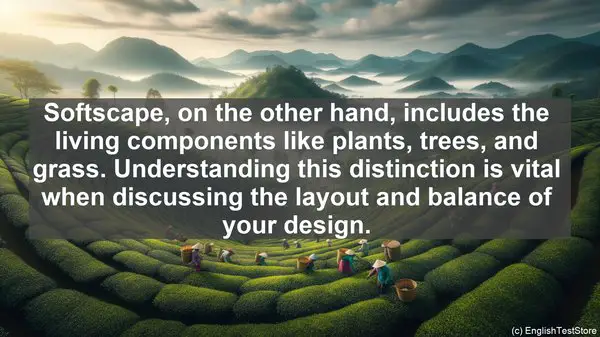
Many people mistake hardscape for softscape and vice versa. Hardscape refers to the non-living elements in a landscape, such as pathways, walls, and structures. Softscape, on the other hand, includes the living components like plants, trees, and grass. Understanding this distinction is vital when discussing the layout and balance of your design.

2. Annual vs. Perennial

Annual plants complete their life cycle within a year, while perennials regrow every year. When planning your garden, consider the longevity and maintenance requirements of each. Annuals offer vibrant colors but need replanting, while perennials provide a more consistent presence.

3. Xeriscape vs. Oasis

Xeriscape and oasis represent two contrasting approaches to landscaping. Xeriscaping focuses on water conservation, using drought-tolerant plants and efficient irrigation. An oasis, on the other hand, is a lush, water-rich environment. The choice depends on factors like climate, resources, and personal preferences.

4. Fertilizer vs. Pesticide

While both are used in plant care, fertilizers and pesticides have distinct roles. Fertilizers provide essential nutrients for growth, while pesticides control pests and diseases. It’s crucial to identify the specific issue and choose the appropriate solution to avoid unintended consequences.

5. Native vs. Exotic

Native plants are indigenous to a particular region, while exotics come from elsewhere. Each has its benefits and considerations. Native plants are well-adapted to the local environment, requiring less maintenance. Exotics can offer unique aesthetics but may need more attention and resources.

6. Pruning vs. Shearing

Pruning and shearing are both techniques to shape and maintain plants, but they differ in approach. Pruning involves selectively removing specific branches or stems to enhance structure and health. Shearing, on the other hand, is a more uniform trimming, often used for hedges or topiaries.

7. Mulch vs. Compost

Mulch and compost are valuable additions to soil, but they serve different purposes. Mulch is a protective layer on the soil surface, conserving moisture and suppressing weeds. Compost, on the other hand, is a nutrient-rich organic matter that improves soil fertility. Both have their roles in a healthy garden.

8. Accent vs. Focal Point

In design, accents and focal points create visual interest. An accent is a smaller element that draws attention, like a unique plant or sculpture. A focal point, on the other hand, is a more prominent feature, such as a grand tree or a water feature. Both contribute to the overall aesthetics and balance.

9. Evergreen vs. Deciduous

Evergreen and deciduous refer to the foliage of plants. Evergreens retain their leaves year-round, providing consistent color and texture. Deciduous plants shed their leaves in the fall, often with vibrant displays. The choice depends on factors like desired seasonal variation and maintenance preferences.

Top 10 Commonly Confused Words in Landscape Architecture

Introduction

Welcome to today’s lesson on landscape architecture. In this lesson, we’ll be discussing the top 10 commonly confused words in this field. Understanding these words correctly is crucial for effective communication and professionalism. So, let’s dive in!

1. Hardscape vs. Softscape

The terms ‘hardscape’ and ‘softscape’ are often used interchangeably, but they have distinct meanings. Hardscape refers to the non-living, man-made elements like pathways, walls, and structures. On the other hand, softscape includes the living elements such as plants, trees, and soil. Remember, hardscape is about the solid, while softscape is about the natural.

2. Sustainability vs. Resilience

While both sustainability and resilience are important concepts in landscape architecture, they differ in focus. Sustainability is about minimizing environmental impact and resource use, ensuring long-term viability. Resilience, on the other hand, is about the ability to bounce back from disturbances, like natural disasters. Think of sustainability as long-term planning and resilience as preparedness for the unexpected.

3. Site Analysis vs. Site Assessment

Site analysis and site assessment are often used interchangeably, but they have different scopes. Site analysis involves studying the physical, environmental, and social aspects of a site. It’s about understanding the context. Site assessment, on the other hand, is more specific, focusing on evaluating the site’s suitability for a particular project. So, analysis is broader, while assessment is more targeted.

4. Urban Design vs. Landscape Design

Urban design and landscape design are closely related but have distinct focuses. Urban design deals with the planning and design of entire urban areas, considering factors like transportation, infrastructure, and public spaces. Landscape design, on the other hand, is about the detailed design of outdoor spaces, emphasizing aesthetics, functionality, and sustainability. Urban design is about the big picture, while landscape design is about the details.

5. Erosion vs. Sedimentation

Erosion and sedimentation are both processes that affect the land, but they differ in action. Erosion is the movement of soil or rock particles by wind, water, or other forces. It’s about the wearing away of the land. Sedimentation, on the other hand, is the deposition of eroded material, leading to the formation of sediment layers. So, erosion is about movement, while sedimentation is about deposition.

6. Permeable vs. Impermeable

Permeable and impermeable are terms used to describe the ability of a material to allow or prevent the passage of water. Permeable materials, like certain types of pavement, allow water to seep through, promoting natural drainage. Impermeable materials, on the other hand, like concrete, prevent water from seeping through, leading to runoff. So, permeable is about allowing water flow, while impermeable is about blocking it.

7. Xeriscaping vs. Zero-scaping

Xeriscaping and zero-scaping are both approaches to landscaping in arid regions, but they differ in philosophy. Xeriscaping involves using drought-tolerant plants, efficient irrigation, and water-conserving techniques. It’s about creating a sustainable, low-water landscape. Zero-scaping, on the other hand, emphasizes minimal water use, often relying on non-living elements like rocks and gravel. So, xeriscaping is about smart water use, while zero-scaping is about minimal water use.

8. Master Plan vs. Concept Plan

Master plan and concept plan are terms used in the planning stages of a project, but they have different levels of detail. A master plan is a comprehensive, long-term plan that outlines the overall vision, goals, and strategies. It’s like a roadmap for the entire project. A concept plan, on the other hand, is a preliminary plan that focuses on the basic layout and design ideas. It’s like a starting point for further development. So, master plan is about the big picture, while concept plan is about the initial ideas.

9. Biophilia vs. Biodiversity

Biophilia and biodiversity are related to the natural world, but they have different meanings. Biophilia is the innate human connection and affinity towards nature. It’s about the emotional and psychological bond with the natural environment. Biodiversity, on the other hand, refers to the variety of living organisms in a particular habitat or ecosystem. It’s about the richness and balance of life forms. So, biophilia is about the human-nature relationship, while biodiversity is about ecological variety.

10. Render vs. Sketch

In the visual representation of design ideas, render and sketch are two common techniques, each with its own purpose. A render is a highly detailed, realistic depiction, often created using computer software. It’s like a virtual image of the final design. A sketch, on the other hand, is a freehand drawing, usually quick and conceptual. It’s like a rough visual exploration. So, render is about precision, while sketch is about capturing the essence.

Top 10 Commonly Confused Words in Kinesiology

Introduction: The Importance of Clear Communication in Kinesiology

Welcome to this lesson where we’ll be discussing the top 10 commonly confused words in Kinesiology. As students in this field, it’s crucial to have a strong grasp of these terms to ensure effective communication in our professional lives.

1. Kinematics vs. Kinetics

Let’s start with a classic confusion: kinematics and kinetics. While both terms deal with the study of motion, kinematics focuses on the description of motion, such as position, velocity, and acceleration, without considering the forces involved. On the other hand, kinetics delves into the forces that cause motion. So, think of kinematics as the ‘what’ and kinetics as the ‘why’ behind motion.

2. Hypertrophy vs. Hyperplasia

Next up, we have hypertrophy and hyperplasia, which are often used interchangeably when discussing muscle growth. However, they refer to different processes. Hypertrophy is the increase in muscle size due to the enlargement of existing muscle fibers, whereas hyperplasia is the increase in muscle size due to the formation of new muscle fibers. So, hypertrophy is about the growth of individual fibers, while hyperplasia is about increasing their number.

3. Flexion vs. Extension

Moving on, let’s clarify the difference between flexion and extension. These terms are commonly used when describing joint movements. Flexion refers to the bending of a joint, reducing the angle between two bones, while extension is the opposite, involving the straightening of a joint, increasing the angle between bones. For example, when you bring your forearm towards your upper arm, that’s flexion, and when you straighten it back, that’s extension.

4. Isotonic vs. Isometric

Now, let’s dive into the world of muscle contractions. Isotonic and isometric are two types of contractions. Isotonic contractions involve muscle length changes, such as when you perform a bicep curl. The muscle shortens during the lifting phase and lengthens during the lowering phase. Isometric contractions, on the other hand, don’t involve any visible movement. The muscle contracts, but its length remains the same. An example of an isometric contraction is pushing against an immovable object.

5. Endurance vs. Stamina

Endurance and stamina are often used synonymously, but they have slight differences. Endurance refers to the ability to sustain a physical activity for an extended period. It’s about the duration. Stamina, on the other hand, is the ability to perform a physical activity at a high intensity. It’s about the intensity. So, while both terms relate to physical capacity, endurance is about time, and stamina is about effort.

6. Proprioception vs. Kinesthesia

Proprioception and kinesthesia are terms used to describe our awareness of body position and movement. Proprioception specifically refers to the sense of the body’s position in space, while kinesthesia encompasses the perception of movement. So, if you’re able to close your eyes and still know where your limbs are, that’s due to proprioception. And if you can accurately perform a dance routine, that’s thanks to kinesthesia.

7. Tendon vs. Ligament

Tendons and ligaments are both connective tissues, but they have different roles. Tendons connect muscles to bones, enabling movement. Ligaments, on the other hand, connect bones to other bones, providing stability to joints. So, think of tendons as the ‘muscle-to-bone’ connectors and ligaments as the ‘bone-to-bone’ stabilizers.

8. Agonist vs. Antagonist

When it comes to muscle actions, we have agonists and antagonists. The agonist is the muscle responsible for the main action, while the antagonist is the muscle that opposes or reverses that action. For example, when you perform a bicep curl, the bicep is the agonist, contracting to lift the weight, while the tricep is the antagonist, relaxing to allow the movement.

9. Hypertonic vs. Hypotonic

Hypertonic and hypotonic are terms used to describe the tonicity of a solution. Hypertonic refers to a solution with a higher solute concentration compared to another solution. It causes water to move out of cells, leading to cell shrinkage. Hypotonic, on the other hand, refers to a solution with a lower solute concentration. It causes water to move into cells, leading to cell swelling.

10. Etiology vs. Pathology

Lastly, let’s differentiate between etiology and pathology. Etiology is the study of the causes or origins of a disease or condition. It’s about understanding why a condition occurs. Pathology, on the other hand, is the study of the nature and effects of a disease or condition. It’s about understanding the characteristics and consequences of a condition. So, etiology is about the ‘why’ and pathology is about the ‘what’ of a disease.