Top 10 Commonly Confused Words in Earth System Science

Introduction

Welcome to our Earth System Science class. Today, we are going to dive into the world of commonly confused words. Understanding these words is essential for a solid foundation in this field. So, let’s get started!

1. Weather vs. Climate

Weather and climate are often used interchangeably, but they have distinct meanings. Weather refers to short-term atmospheric conditions, such as temperature, precipitation, and wind. On the other hand, climate represents long-term patterns of weather in a specific region. While weather can change rapidly, climate is more stable and predictable.
2. Erosion vs. Weathering

Erosion and weathering both involve the breakdown of rocks, but they differ in the process. Weathering is the gradual disintegration of rocks due to exposure to elements like water, wind, and temperature changes. Erosion, however, refers to the transportation and deposition of these weathered materials by agents like water, ice, or wind.

3. Renewable vs. Non-renewable Energy

Renewable energy sources, like solar and wind power, can be replenished naturally. They have a virtually unlimited supply. Non-renewable energy sources, such as fossil fuels, are finite and take millions of years to form. Once depleted, they cannot be easily replaced.

4. Greenhouse Effect vs. Global Warming

The greenhouse effect is a natural process that traps heat in the Earth’s atmosphere, making it suitable for life. However, human activities, like burning fossil fuels, have intensified this effect, leading to global warming. While the greenhouse effect is necessary, global warming has detrimental consequences, such as rising sea levels and extreme weather events.

5. Weather vs. Climate Change

Weather change refers to short-term variations in atmospheric conditions. Climate change, on the other hand, signifies long-term alterations in temperature, precipitation, and other factors. While weather can fluctuate daily, climate change occurs over decades or centuries, primarily due to human activities.

6. Ozone Layer vs. Greenhouse Gases

The ozone layer is a region in the Earth’s stratosphere that shields us from harmful ultraviolet (UV) radiation. Greenhouse gases, like carbon dioxide and methane, trap heat in the atmosphere. While the ozone layer depletion is a concern, the accumulation of greenhouse gases is a major contributor to global warming.

7. Weather Forecast vs. Climate Projection

A weather forecast predicts short-term atmospheric conditions, usually up to a week. On the other hand, a climate projection provides long-term estimates of climate patterns, often for decades or centuries. While weather forecasts help plan daily activities, climate projections are crucial for understanding future climate scenarios.

8. Weathering vs. Deposition

Weathering, as we discussed earlier, is the breakdown of rocks. Deposition, however, is the process of depositing these weathered materials in a new location. Agents like water, wind, or ice transport the eroded particles and deposit them elsewhere, shaping the Earth’s surface over time.

9. Latitude vs. Longitude

Latitude and longitude are both geographical coordinates, but they represent different aspects. Latitude measures the distance north or south of the equator, while longitude indicates the distance east or west of the prime meridian. Together, they provide precise locations on the Earth’s surface.

10. Weather vs. Climate Data

Weather data refers to the current atmospheric conditions, such as temperature, humidity, and wind speed. Climate data, on the other hand, represents long-term averages and trends in these variables. By analyzing climate data, scientists can understand climate patterns and changes over time.
Top 10 Commonly Confused Words in Earth Science

Introduction

Today, we’re going to dive into the fascinating world of Earth Science. As you explore this subject, you may come across some words that seem similar but have distinct meanings. These words can be confusing, but fear not! In this lesson, we’ll clarify the top 10 commonly confused words in Earth Science.

1. Weather vs. Climate

The first pair of words that often causes confusion is ‘weather’ and ‘climate.’ While they both deal with atmospheric conditions, they differ in their scope. Weather refers to short-term conditions, such as temperature and precipitation, in a specific area. On the other hand, climate describes long-term patterns of weather in a region. So, while you can expect a rainy day (weather) in a tropical rainforest, the overall climate of that region is characterized by high precipitation.

2. Erosion vs. Weathering

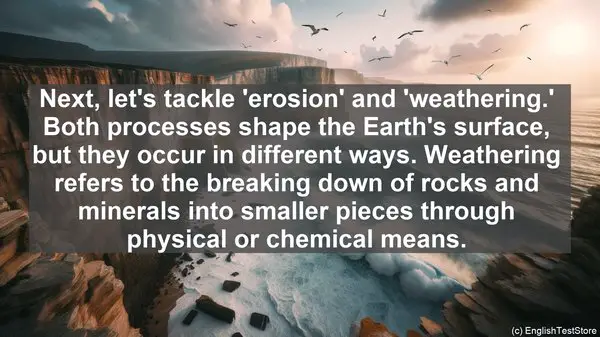
Next, let’s tackle ‘erosion’ and ‘weathering.’ Both processes shape the Earth’s surface, but they occur in different ways. Weathering refers to the breaking down of rocks and minerals into smaller pieces through physical or chemical means. Erosion, on the other hand, involves the transport of these weathered materials by wind, water, or ice. In simpler terms, weathering is the ‘breaking’ while erosion is the ‘carrying away.’

3. Latitude vs. Longitude

Moving on to geography, we have ‘latitude’ and ‘longitude.’ These lines help us pinpoint locations on the Earth’s surface. Latitude lines run parallel to the equator and measure the distance north or south of it. In contrast, longitude lines, also known as meridians, run from pole to pole and measure the distance east or west of the Prime Meridian. So, if you’re giving someone directions, you’ll need both latitude and longitude coordinates.

4. Renewable vs. Non-Renewable

When discussing energy sources, it’s crucial to understand the difference between ‘renewable’ and ‘non-renewable.’ Renewable resources, like solar and wind energy, can be replenished naturally over time. Non-renewable resources, such as fossil fuels, are finite and take millions of years to form. As we strive for sustainable practices, the focus is on utilizing more renewable sources to reduce our dependence on non-renewable ones.

5. Weathering vs. Erosion

Wait, didn’t we cover this already? Yes, but it’s a common mix-up. Remember, weathering is the breakdown of rocks, while erosion is the transportation of those weathered materials. Think of it as weathering being the ‘preparation’ stage, and erosion being the ‘movement’ stage.

6. Evaporation vs. Condensation

Now, let’s delve into the water cycle. ‘Evaporation’ and ‘condensation’ are two vital steps in this process. Evaporation occurs when water changes from a liquid to a gas, usually due to heat. Condensation, on the other hand, is the opposite. It’s when water vapor cools and changes back into a liquid, forming clouds. So, the next time you see a cloud, remember it’s a result of condensation.

7. Revolution vs. Rotation

When it comes to celestial movements, ‘revolution’ and ‘rotation’ are often confused. Revolution refers to the Earth’s yearly orbit around the Sun, which takes approximately 365 days. On the other hand, rotation is the Earth’s daily spin on its axis, completing one full rotation in about 24 hours. So, while rotation gives us day and night, revolution is responsible for our changing seasons.

8. Igneous vs. Sedimentary

In geology, we encounter various rock types. Two of the most common ones are ‘igneous’ and ‘sedimentary.’ Igneous rocks form from the cooling and solidification of molten material, such as lava or magma. Sedimentary rocks, on the other hand, are created through the accumulation and compaction of sediments over time. So, if you find a rock with visible layers, chances are it’s sedimentary.

9. Revolution vs. Rotation

Wait, didn’t we cover this already? Yes, but it’s a common mix-up. Remember, revolution is the Earth’s yearly orbit around the Sun, while rotation is its daily spin on its axis. Revolution leads to our changing seasons, while rotation gives us day and night.

10. Volcano vs. Earthquake

Our final pair of words, ‘volcano’ and ‘earthquake,’ both involve the Earth’s dynamic nature. A volcano is a vent in the Earth’s crust through which molten rock, ash, and gases are ejected. It’s essentially a mountain that forms from volcanic activity. On the other hand, an earthquake is a sudden release of energy in the Earth’s crust, resulting in shaking. So, while a volcano is associated with eruptions, an earthquake is characterized by ground movement.

Top 10 Commonly Confused Words in Disaster Risk Reduction

Introduction

Welcome to our lesson on the top 10 commonly confused words in Disaster Risk Reduction. As students, it’s crucial to have a strong grasp of these terms, as they form the foundation of our understanding in this field.

1. Hazard vs. Risk

Often used interchangeably, hazard and risk have distinct meanings. A hazard refers to a potential source of harm, like an earthquake. On the other hand, risk is the probability of that hazard causing damage or loss. Understanding the difference is essential in assessing and mitigating potential dangers.

2. Mitigation vs. Preparedness

While both terms relate to reducing the impact of disasters, they differ in timing. Mitigation focuses on actions taken before a disaster to prevent or minimize its effects. Preparedness, on the other hand, involves the steps taken in advance to ensure an effective response when a disaster strikes.

3. Resilience vs. Sustainability

Resilience and sustainability are often used in the context of long-term planning. Resilience refers to the ability of a system or community to bounce back and recover quickly from a disaster. Sustainability, on the other hand, focuses on ensuring the long-term well-being of the environment and society.

4. Evacuation vs. Shelter-in-Place

During a disaster, two common strategies are evacuation and shelter-in-place. Evacuation involves moving people away from the affected area to a safer location. Shelter-in-place, on the other hand, means staying indoors and taking necessary precautions. The choice between the two depends on the specific situation and guidance from authorities.

5. Response vs. Recovery

In the aftermath of a disaster, response and recovery are two distinct phases. Response involves the immediate actions taken to address the situation, such as search and rescue. Recovery, on the other hand, focuses on the long-term rebuilding and restoration of the affected area.

6. Vulnerability vs. Capacity

When assessing a community’s preparedness, vulnerability and capacity are key considerations. Vulnerability refers to the susceptibility of a community to a hazard, taking into account factors like infrastructure and social dynamics. Capacity, on the other hand, relates to the resources and abilities available to respond effectively.

7. Adaptation vs. Mitigation

Both adaptation and mitigation are strategies to address climate change and its impacts. Adaptation involves adjusting to the changes that are already occurring. Mitigation, on the other hand, focuses on reducing greenhouse gas emissions to prevent further climate change.

8. Early Warning vs. Forecast

In the context of natural disasters, early warning and forecast are often used. An early warning system provides advance notice of an impending event, giving people time to take necessary actions. A forecast, on the other hand, predicts the general weather conditions over a specific period.

9. Recovery vs. Reconstruction

While recovery and reconstruction are related to the post-disaster phase, they differ in scope. Recovery involves the broader process of restoring the affected area, including social and economic aspects. Reconstruction, on the other hand, specifically refers to the physical rebuilding of infrastructure.

10. Mainstreaming vs. Standalone

When integrating disaster risk reduction into various sectors, two approaches are commonly used. Mainstreaming involves incorporating it into existing policies and programs. Standalone, on the other hand, refers to dedicated initiatives solely focused on disaster risk reduction.

Top 10 Commonly Confused Words in Disaster Medicine

Introduction

Welcome to today’s lesson on disaster medicine. In this lesson, we’ll be discussing the top 10 commonly confused words in this field. Understanding these distinctions is crucial for effective communication and decision-making during emergencies.

1. Epidemic vs. Pandemic

While both terms refer to the spread of a disease, there’s a key difference. An epidemic is the rapid increase in cases of a disease within a specific region or community. On the other hand, a pandemic is a global outbreak, affecting multiple countries or continents. COVID-19, for instance, is a pandemic.

2. Triage vs. Treatment

During a disaster, medical resources may be scarce. Triage involves quickly assessing and prioritizing patients based on the severity of their condition. Treatment, on the other hand, is the actual medical care provided to the patients. Triage helps allocate resources effectively.

3. Isolation vs. Quarantine

Both isolation and quarantine involve separating individuals to prevent the spread of a disease. Isolation is for those who are already sick, keeping them away from healthy individuals. Quarantine, on the other hand, is for those who may have been exposed to a disease but aren’t showing symptoms yet.

4. Mitigation vs. Preparedness

While both terms are related to disaster management, they focus on different stages. Mitigation involves actions taken to reduce the impact of a disaster before it occurs. Preparedness, on the other hand, refers to the measures taken in advance to ensure an effective response when a disaster strikes.

5. Shelter-in-Place vs. Evacuation

During certain emergencies, like a chemical spill, authorities may advise either sheltering-in-place or evacuation. Shelter-in-place means staying indoors, sealing off any openings, and waiting for further instructions. Evacuation, on the other hand, involves leaving the area and moving to a safer location.

6. Decontamination vs. Sterilization

In disaster medicine, decontamination and sterilization are crucial. Decontamination is the process of removing or neutralizing contaminants, reducing their harmful effects. Sterilization, on the other hand, involves killing or eliminating all microorganisms, making an object or area completely free of pathogens.

7. Casualty vs. Fatality

While both terms refer to individuals affected by a disaster, there’s a distinction. A casualty is anyone who is injured, missing, or killed. A fatality, on the other hand, specifically refers to someone who has died as a result of the disaster.

8. Incident Command System vs. Emergency Operations Center

During a disaster, effective coordination is crucial. The Incident Command System (ICS) is a standardized approach used to manage incidents, ensuring clear roles and responsibilities. The Emergency Operations Center (EOC), on the other hand, is a physical location where coordination and strategic decisions are made.

9. Primary vs. Secondary Survey

In disaster medicine, when assessing patients, there are two main surveys. The primary survey is a rapid assessment to identify and address life-threatening conditions. The secondary survey, which is more detailed, is conducted once the immediate threats have been addressed.

10. Mass Casualty Incident vs. Multiple Casualty Incident

Both terms refer to incidents with a large number of casualties. However, there’s a difference in scale. A mass casualty incident typically involves a significant number of casualties that may overwhelm the local resources. A multiple casualty incident, though serious, may not have the same scale as a mass casualty incident.

Top 10 Commonly Confused Words in Digital Media Production

Introduction

Hello everyone, and welcome to today’s lesson. In the world of digital media production, there are several words that often get mixed up. Whether you’re a student or a professional, having a firm grasp on these terms is crucial. So, let’s dive in and explore the top 10 commonly confused words in digital media production.

1. Codec vs. Format

One of the most common confusions is between ‘codec’ and ‘format.’ While both terms relate to the way digital media is encoded and stored, they have distinct meanings. A codec is the software or algorithm used to compress and decompress data, while a format refers to the container that holds the compressed data. So, think of the codec as the ‘how’ and the format as the ‘where.’

2. Resolution vs. Aspect Ratio

When it comes to the visual elements of a media file, ‘resolution’ and ‘aspect ratio’ are often used interchangeably. However, they represent different aspects. Resolution refers to the number of pixels in an image or lesson, while aspect ratio is the proportional relationship between the width and height. So, while resolution determines the clarity, aspect ratio affects the overall shape and composition.

3. Bitrate vs. File Size

While discussing media files, ‘bitrate’ and ‘file size’ are two terms that are frequently confused. Bitrate is the amount of data processed per unit of time, usually measured in kilobits per second (Kbps) or megabits per second (Mbps). On the other hand, file size is the total amount of data a file occupies on storage, typically measured in kilobytes (KB) or megabytes (MB). So, bitrate is about data transfer, while file size is about storage space.

4. Keyframe vs. Frame

In lesson editing, ‘keyframe’ and ‘frame’ are often used without distinction. However, they have different roles. A frame is a complete image in a lesson, while a keyframe is a specific frame that marks a significant change or transition. Keyframes are essential for animation and effects, as they define the starting and ending points of a change.

5. B-roll vs. A-roll

When it comes to footage, ‘B-roll’ and ‘A-roll’ are terms you’ll frequently encounter. A-roll refers to the primary footage, usually featuring the main subject or action. B-roll, on the other hand, is supplementary footage used to enhance the storytelling or provide context. It’s often used in interviews or documentaries to cut away from the main shot.

6. Lavalier vs. Shotgun

In the realm of audio, ‘lavalier’ and ‘shotgun’ are two types of microphones. A lavalier microphone, also known as a lapel mic, is a small device that can be clipped onto clothing, offering hands-free operation. On the other hand, a shotgun microphone is highly directional, capturing sound from a narrow field. It’s often used in film production to capture dialogue or specific sounds.

7. Dolly vs. Zoom

When it comes to camera movements, ‘dolly’ and ‘zoom’ are frequently confused. Dolly refers to physically moving the camera towards or away from the subject, creating a smooth and dynamic effect. On the other hand, zoom involves adjusting the lens focal length to make the subject appear closer or farther. While both techniques change the perspective, they have different visual qualities.

8. Script vs. Storyboard

In the pre-production phase, ‘script’ and ‘storyboard’ are two essential elements. A script is a written document that outlines the dialogue, actions, and overall narrative. It’s more focused on the textual aspect. On the other hand, a storyboard is a visual representation, often consisting of sketches or images, that helps in visualizing the shots and sequence. It’s like a comic book version of the script.

9. Export vs. Render

When it’s time to finalize a project, ‘export’ and ‘render’ are the terms you’ll encounter. Exporting involves converting the project file into a playable format, often with various settings and options. Rendering, on the other hand, is the process of generating the final lesson by processing all the effects, transitions, and elements. So, exporting is about the output, while rendering is about the creation.

10. Thumbnail vs. Poster Frame

Finally, in the realm of online media, ‘thumbnail’ and ‘poster frame’ are two terms that are often used interchangeably. A thumbnail is a small, representative image that gives a preview of the content. It’s commonly seen in lesson platforms or search results. On the other hand, a poster frame is a specific frame from the lesson that’s chosen as the main visual representation. It’s often used in lesson players or sharing links.

Top 10 Commonly Confused Words in Digital Humanities

Introduction

Welcome to today’s lesson. In the field of Digital Humanities, there are several words that often cause confusion. Whether you’re a beginner or an experienced student, it’s essential to have a clear understanding of these terms. In this lesson, we’ll be discussing the top 10 commonly confused words in Digital Humanities. So, let’s dive right in!

1. Metadata vs. Meta-analysis

First up, we have metadata and meta-analysis. While both terms sound similar, they have distinct meanings. Metadata refers to the descriptive information about a digital resource, such as its author, date, or format. On the other hand, meta-analysis is a statistical technique that combines data from multiple studies to draw meaningful conclusions. So, remember, metadata is about information, and meta-analysis is about analysis.

2. Digitalization vs. Digitization

Next, let’s talk about digitalization and digitization. These terms often get used interchangeably, but they have different nuances. Digitalization refers to the process of transforming analog content, like books or images, into a digital format. Digitization, on the other hand, is specifically about converting physical materials, such as manuscripts or photographs, into digital files. So, digitalization is broader, while digitization is more focused on physical-to-digital conversion.

3. Data Mining vs. Text Mining

Moving on, we have data mining and text mining. While both involve extracting information from large datasets, they differ in their scope. Data mining is a broader term that encompasses the analysis of any type of data, including numerical or categorical. Text mining, as the name suggests, is specifically about extracting insights from textual data, like articles or social media posts. So, if you’re working with text, text mining is the term to use.

4. Digital Preservation vs. Digital Curation

Now, let’s discuss digital preservation and digital curation. These terms are often used in the context of maintaining and managing digital resources. Digital preservation focuses on ensuring the long-term accessibility and usability of digital content, while digital curation involves the active selection, organization, and presentation of digital materials. So, preservation is about long-term access, and curation is about active management.

5. Open Access vs. Open Source

Next, we have open access and open source. While both terms relate to the availability of resources, they have different applications. Open access refers to making scholarly research or publications freely available to the public. Open source, on the other hand, pertains to software or code that is freely available, allowing users to modify and distribute it. So, open access is about research, and open source is about software.

6. Algorithm vs. Artificial Intelligence

Moving on, let’s clarify the difference between algorithm and artificial intelligence. An algorithm is a step-by-step set of instructions for solving a problem or completing a task. Artificial intelligence, on the other hand, refers to the development of machines or systems that can perform tasks that typically require human intelligence, such as speech recognition or decision-making. So, algorithms are the building blocks of AI.

7. Visualization vs. Infographic

Now, let’s talk about visualization and infographic. Both terms involve presenting information visually, but they have different purposes. Visualization is the general term for representing data or information visually, often using charts, graphs, or maps. An infographic, on the other hand, is a specific type of visual representation that combines text, images, and graphics to convey complex information in a concise and engaging manner. So, if you want to create a visually appealing and informative piece, an infographic is the way to go.

8. User Interface vs. User Experience

Next, let’s discuss user interface and user experience. In the world of design, these terms often come up. User interface, often abbreviated as UI, refers to the visual elements and controls that users interact with when using a digital product or system. User experience, or UX, encompasses the overall experience and satisfaction a user has while interacting with a product, including factors like ease of use, efficiency, and enjoyment. So, UI is about the interface, and UX is about the holistic experience.

9. Machine Learning vs. Deep Learning

Now, let’s dive into the realm of machine learning and deep learning. While both are subsets of artificial intelligence, they differ in their approaches. Machine learning involves training a model on data to make predictions or decisions, often based on patterns or statistical analysis. Deep learning, on the other hand, is a more advanced form of machine learning that uses artificial neural networks to simulate human-like decision-making. So, deep learning is a subset of machine learning, but with more complex algorithms.

10. Digital Divide vs. Digital Inclusion

Lastly, let’s explore the concepts of digital divide and digital inclusion. The digital divide refers to the gap between those who have access to digital technologies and those who don’t, often due to factors like income, geography, or education. Digital inclusion, on the other hand, is about ensuring that everyone has equal opportunities and access to digital resources and skills. So, digital inclusion is the goal to bridge the digital divide.

Top 10 Commonly Confused Words in Digital Forensics

Introduction: The World of Digital Forensics

Welcome to our digital forensics series. Today, we’re diving into a topic that often trips up even the most experienced professionals – commonly confused words. In the fast-paced world of digital investigations, precise terminology is key. So, without further ado, let’s get started!

1. Data vs. Metadata

Data and metadata are two terms that are frequently used interchangeably. However, they have distinct meanings. Data refers to the actual content, like the text in a document or an image. On the other hand, metadata provides information about the data, such as the date created, author, and even the device used. Understanding the difference is crucial, as metadata can often be a goldmine of valuable insights.

2. Encryption vs. Hashing

Encryption and hashing are both techniques used to secure data, but they serve different purposes. Encryption is reversible, meaning the data can be decrypted with the right key. It’s like putting a document in a safe with a lock. Hashing, on the other hand, is irreversible. It generates a unique string of characters, like a digital fingerprint, for a file. This is useful for verifying data integrity, but it can’t be reversed to retrieve the original content.

3. Volatile vs. Non-Volatile Memory

When it comes to memory, there are two main types: volatile and non-volatile. Volatile memory, like RAM, requires constant power to retain data. Once the power is cut, the data is gone. Non-volatile memory, such as hard drives or solid-state drives, retains data even without power. In digital forensics, understanding the distinction is crucial, as volatile memory can hold valuable information that’s lost once the system is shut down.

4. Acquisition vs. Analysis

Acquisition and analysis are two fundamental steps in digital forensics. Acquisition refers to the process of collecting data from a source, be it a computer, a mobile device, or a network. It’s like gathering evidence from a crime scene. Analysis, on the other hand, involves examining and interpreting the acquired data. It’s the stage where patterns, anomalies, and insights are discovered. Both steps are equally important and require meticulous attention to detail.

5. File Carving vs. File Recovery

File carving and file recovery are techniques used to retrieve deleted or damaged files. File carving involves searching for file signatures or specific patterns within a storage device to reconstruct the file. It’s like putting together a jigsaw puzzle. File recovery, on the other hand, focuses on restoring files from unallocated space or damaged sectors. Both techniques have their place in digital forensics, depending on the scenario.

6. Incident Response vs. Digital Forensics

While incident response and digital forensics are related, they have distinct objectives. Incident response is all about containing, mitigating, and recovering from a security incident. It’s like the immediate response to a fire alarm. Digital forensics, on the other hand, is the in-depth investigation that follows. It’s like the post-incident analysis to determine the cause, extent, and impact. Both are crucial for effective incident management.

7. Steganography vs. Encryption

Steganography and encryption are techniques used to protect data, but they work in different ways. Encryption focuses on making data unreadable to unauthorized individuals. It’s like writing a message in a secret code. Steganography, on the other hand, is about hiding the existence of data. It’s like concealing a message within an innocent-looking image. Both techniques have their applications in digital forensics, depending on the scenario.

8. Timestamp vs. Timeline

In digital forensics, timestamps and timelines are essential for reconstructing events. A timestamp is a specific point in time, like the creation time of a file. It’s like a snapshot. A timeline, on the other hand, is a chronological sequence of events, often with additional information. It’s like a detailed log. Both are crucial for establishing the sequence of actions and building a comprehensive picture of an incident.

9. Imaging vs. Cloning

Imaging and cloning are both methods used to create a forensic copy of a storage device. Imaging involves creating a bit-by-bit copy of the source, including both allocated and unallocated space. It’s like taking a complete snapshot. Cloning, on the other hand, creates a copy of the allocated space only, excluding unallocated or empty areas. Both methods have their advantages and are chosen based on the specific requirements of the investigation.

10. Chain of Custody vs. Continuity of Evidence

Chain of custody and continuity of evidence are crucial concepts in digital forensics, especially when it comes to legal proceedings. Chain of custody refers to the documented trail that establishes the control and integrity of evidence from the time it’s collected until it’s presented in court. Continuity of evidence, on the other hand, focuses on ensuring that the evidence remains unchanged and unaltered throughout the investigation. Both are vital for maintaining the admissibility and credibility of evidence.

Top 10 Commonly Confused Words in Diagnostic Radiology

Introduction

Hello everyone, and welcome to today’s lesson. Diagnostic radiology is a fascinating field, but it’s not without its challenges. One of the areas where students often stumble is in the correct usage of certain words. In this lesson, we’ll be discussing the top 10 commonly confused words in diagnostic radiology, and by the end, you’ll have a much clearer understanding of these terms. So, let’s dive in!

1. Sensitivity vs. Specificity

The first pair of words that often cause confusion are sensitivity and specificity. While they may sound similar, they have distinct meanings. Sensitivity refers to a test’s ability to correctly identify those with the condition, while specificity is its ability to correctly identify those without the condition. So, in essence, sensitivity is about avoiding false negatives, while specificity is about avoiding false positives.

2. Benign vs. Malignant

When it comes to describing a tumor or a growth, the terms benign and malignant are commonly used. Benign refers to a non-cancerous growth, while malignant indicates a cancerous one. It’s crucial to differentiate between the two, as the treatment and prognosis can vary significantly.

3. Axial vs. Coronal vs. Sagittal

Radiological images are often presented in different planes: axial, coronal, and sagittal. Axial refers to a horizontal cut, coronal to a vertical one from front to back, and sagittal to a vertical one from side to side. Understanding these terms is essential for accurate interpretation of images.

4. Sensitivity vs. Specificity

The first pair of words that often cause confusion are sensitivity and specificity. While they may sound similar, they have distinct meanings. Sensitivity refers to a test’s ability to correctly identify those with the condition, while specificity is its ability to correctly identify those without the condition. So, in essence, sensitivity is about avoiding false negatives, while specificity is about avoiding false positives.

5. T1-weighted vs. T2-weighted

In magnetic resonance imaging (MRI), T1-weighted and T2-weighted images are commonly used. T1-weighted images provide excellent anatomical detail, while T2-weighted images are better at highlighting pathology. Each has its role, and understanding when to use which is crucial for accurate diagnosis.

6. Hypoechoic vs. Hyperechoic

When it comes to ultrasound, hypoechoic and hyperechoic are frequently encountered. Hypoechoic refers to an area that appears darker than the surrounding tissue, while hyperechoic indicates an area that appears brighter. These terms help in characterizing structures and identifying abnormalities.

7. Sensitivity vs. Specificity

The first pair of words that often cause confusion are sensitivity and specificity. While they may sound similar, they have distinct meanings. Sensitivity refers to a test’s ability to correctly identify those with the condition, while specificity is its ability to correctly identify those without the condition. So, in essence, sensitivity is about avoiding false negatives, while specificity is about avoiding false positives.

8. Sensitivity vs. Specificity

The first pair of words that often cause confusion are sensitivity and specificity. While they may sound similar, they have distinct meanings. Sensitivity refers to a test’s ability to correctly identify those with the condition, while specificity is its ability to correctly identify those without the condition. So, in essence, sensitivity is about avoiding false negatives, while specificity is about avoiding false positives.

9. Sensitivity vs. Specificity

The first pair of words that often cause confusion are sensitivity and specificity. While they may sound similar, they have distinct meanings. Sensitivity refers to a test’s ability to correctly identify those with the condition, while specificity is its ability to correctly identify those without the condition. So, in essence, sensitivity is about avoiding false negatives, while specificity is about avoiding false positives.

10. Sensitivity vs. Specificity

The first pair of words that often cause confusion are sensitivity and specificity. While they may sound similar, they have distinct meanings. Sensitivity refers to a test’s ability to correctly identify those with the condition, while specificity is its ability to correctly identify those without the condition. So, in essence, sensitivity is about avoiding false negatives, while specificity is about avoiding false positives.

Top 10 Commonly Confused Words in Developmental Psychopathology

Introduction

Welcome to today’s lesson on the top 10 commonly confused words in Developmental Psychopathology. As students in this field, it’s crucial to have a clear understanding of these terms. So, let’s dive right in!

1. Prevalence vs. Incidence

Prevalence refers to the total number of cases of a particular disorder in a given population, while incidence represents the number of new cases occurring within a specific time frame. Understanding the difference between these two terms is essential for accurate research and analysis.

2. Etiology vs. Pathogenesis

Etiology refers to the cause or origin of a disorder, while pathogenesis focuses on the development and progression of the condition. Both terms are vital in understanding the factors contributing to a disorder and its subsequent effects.

3. Comorbidity vs. Co-occurrence

Comorbidity refers to the presence of two or more disorders in the same individual, often with shared risk factors or underlying mechanisms. On the other hand, co-occurrence simply indicates the simultaneous presence of two conditions, without implying a direct relationship.

4. Sensitivity vs. Specificity

Sensitivity measures the ability of a diagnostic test to correctly identify individuals with a particular disorder, while specificity gauges its accuracy in ruling out the condition in those who do not have it. Both aspects are crucial for an effective diagnostic tool.

5. Internalizing vs. Externalizing Disorders

Internalizing disorders, such as anxiety and depression, are characterized by inward-focused symptoms, while externalizing disorders, like conduct disorder, manifest through outward behaviors. Recognizing these distinctions aids in accurate diagnosis and treatment planning.

6. Resilience vs. Recovery

Resilience refers to the ability to bounce back from adversity and adapt to challenges, while recovery signifies the restoration of functioning after a period of illness or impairment. Both concepts highlight the potential for positive outcomes in the face of difficulties.

7. Risk vs. Protective Factors

Risk factors increase the likelihood of developing a disorder, while protective factors mitigate or reduce the chances. Identifying and addressing both types of factors is crucial for effective prevention and intervention strategies.

8. Neurodevelopmental vs. Neurodegenerative

Neurodevelopmental disorders, like autism, originate during early brain development, while neurodegenerative conditions, such as Alzheimer’s, involve the progressive deterioration of brain function over time. Understanding these distinctions aids in accurate diagnosis and appropriate interventions.

9. Symptom vs. Syndrome

A symptom is a single characteristic or manifestation of a disorder, while a syndrome refers to a collection of symptoms that often occur together. Distinguishing between these terms is essential for accurate diagnosis and treatment planning.

10. Validity vs. Reliability

Validity refers to the degree to which a test measures what it intends to measure, while reliability gauges the consistency and stability of the test’s results. Both aspects are crucial for ensuring the accuracy and usefulness of assessments in the field of psychopathology.

Top 10 Commonly Confused Words in Developmental Psychology

Introduction

Welcome to our lesson on the top 10 commonly confused words in developmental psychology. As students, it’s essential to have a clear understanding of these terms for our studies and future careers. So, let’s dive in!

Nature vs. Nurture

One of the most debated topics in psychology, ‘nature’ refers to our genetic makeup, while ‘nurture’ encompasses the environmental factors that shape us. Understanding the interplay between these two is crucial in developmental psychology.

Assimilation vs. Accommodation

When it comes to learning, ‘assimilation’ is the process of fitting new information into existing mental frameworks, while ‘accommodation’ involves modifying those frameworks to incorporate new knowledge.

Scaffolding vs. Zone of Proximal Development

In the context of learning, ‘scaffolding’ refers to the support provided by a teacher or mentor, while the ‘zone of proximal development’ is the range of tasks a learner can perform with guidance but not independently.

Critical Period vs. Sensitive Period

Both terms refer to specific time frames in a person’s development when they are more receptive to certain experiences or learning. However, a ‘critical period’ denotes a more rigid timeframe, while a ‘sensitive period’ is more flexible.

Egocentrism vs. Theory of Mind

During early childhood, children often exhibit ‘egocentrism,’ where they struggle to see things from others’ perspectives. ‘Theory of mind’ is the ability to understand that others have different thoughts, beliefs, and intentions.

Classical Conditioning vs. Operant Conditioning

Both are fundamental concepts in behavioral psychology. ‘Classical conditioning’ involves learning through associations, while ‘operant conditioning’ focuses on the consequences of behavior, such as rewards and punishments.

Gender Identity vs. Gender Role

While ‘gender identity’ refers to an individual’s deeply felt sense of being male, female, or non-binary, ‘gender role’ encompasses the societal expectations and behaviors associated with being male or female.

Secure Attachment vs. Insecure Attachment

In the context of parent-child relationships, ‘secure attachment’ is characterized by trust and a sense of safety, whereas ‘insecure attachment’ can manifest as anxiety, avoidance, or ambivalence.

Conservation vs. Irreversibility

‘Conservation’ is the understanding that certain properties of an object, like its quantity or volume, remain the same despite changes in appearance. ‘Irreversibility’ refers to the inability to mentally reverse a series of steps or actions.