
Introduction
Today, we’re going to delve into the fascinating world of soil biodiversity. But before we begin, it’s crucial to clarify some commonly confused words that often arise in this field.
1. Species vs. Genus
One of the fundamental distinctions in taxonomy is between species and genus. While a species refers to a group of organisms that share similar characteristics and can interbreed, a genus encompasses multiple related species.
2. Decomposer vs. Detritivore
Decomposers and detritivores both play vital roles in the breakdown of organic matter. However, decomposers, like fungi, primarily rely on external digestion, while detritivores, such as earthworms, ingest and break down organic material internally.
3. Abiotic vs. Biotic
When studying soil ecosystems, it’s essential to consider both abiotic and biotic factors. Abiotic factors, such as temperature and pH, are non-living components, while biotic factors encompass the living organisms within the ecosystem.
4. Habitat vs. Niche
While often used interchangeably, habitat and niche have distinct meanings. A habitat refers to the physical environment where an organism resides, while a niche encompasses the organism’s role, interactions, and resources within that habitat.
5. Mutualism vs. Commensalism
Mutualism and commensalism are two types of symbiotic relationships. In mutualism, both organisms benefit, while in commensalism, one organism benefits, and the other is unaffected.
6. Primary vs. Secondary Succession
Succession refers to the process of ecological change over time. Primary succession occurs in areas devoid of life, while secondary succession happens in areas where an ecosystem has been disturbed but not completely destroyed.
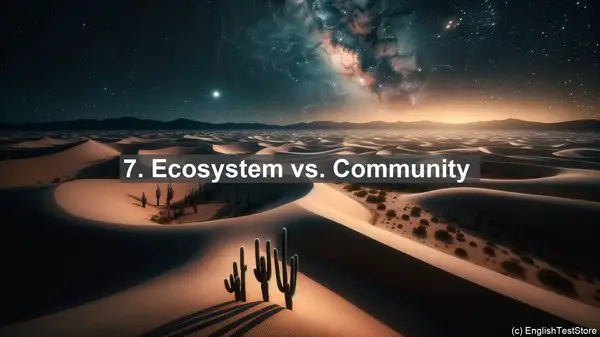
7. Ecosystem vs. Community
An ecosystem comprises both the living (community) and non-living (abiotic) components of an environment. While a community refers specifically to the interacting populations of organisms within an area.
8. Autotroph vs. Heterotroph
Autotrophs, like plants, can produce their own food through photosynthesis. In contrast, heterotrophs, such as animals, rely on consuming other organisms for energy.
9. Microhabitat vs. Macrohabitat
Habitats can vary in scale. A microhabitat refers to a small, localized environment within a larger habitat, while a macrohabitat encompasses larger, more extensive areas.
10. Keystone Species vs. Indicator Species
Keystone species have a disproportionate impact on their ecosystem, often influencing the structure and diversity of the community. Indicator species, on the other hand, can provide valuable insights into the overall health and condition of an ecosystem.