
Introduction
Welcome to today’s lesson on coastal engineering. In this lesson, we’ll be focusing on the top 10 words that often cause confusion in this field. Understanding these terms is crucial for any aspiring coastal engineer. So, let’s dive right in!
1. Tidal vs. Wave
One of the most fundamental distinctions in coastal engineering is between tides and waves. While both are related to the movement of water, tides are primarily caused by the gravitational pull of the moon and sun, resulting in regular, predictable patterns. On the other hand, waves are generated by wind, storms, or even seismic activity, and they can vary in size, frequency, and direction.
2. Erosion vs. Deposition
Erosion and deposition are two opposing processes that shape our coastlines. Erosion refers to the gradual wearing away of land or sediment, often due to the force of waves or currents. Deposition, on the other hand, involves the accumulation of sediment, resulting in the formation of new landforms. Both processes are essential to understand when planning coastal projects.
3. Breakwater vs. Seawall
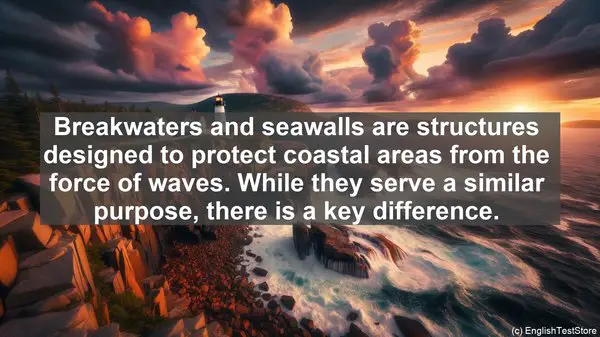
Breakwaters and seawalls are structures designed to protect coastal areas from the force of waves. While they serve a similar purpose, there is a key difference. Breakwaters are offshore barriers, often made of rocks or concrete, that reduce wave energy before it reaches the shore. Seawalls, on the other hand, are built parallel to the coastline and act as a barrier against wave action. Choosing the right structure depends on various factors, including the desired level of wave reduction and the local environment.
4. Groin vs. Jetty
Groins and jetties are another pair of structures commonly used in coastal engineering. Both are built perpendicular to the shoreline and aim to trap sediment. However, there is a difference in their purpose. Groins are typically shorter and are designed to prevent beach erosion by trapping sand. Jetties, on the other hand, are longer and often used to maintain navigation channels by preventing sediment accumulation. Understanding their distinct functions is crucial when considering coastal management strategies.
5. Estuary vs. Lagoon
Estuaries and lagoons are coastal features that are often confused. An estuary is a partially enclosed coastal body of water where freshwater from rivers and streams meets and mixes with seawater. They are highly productive ecosystems and serve as important habitats for various species. Lagoons, on the other hand, are shallow, often brackish water bodies that are separated from the open ocean by barrier islands or spits. They are typically found in areas with low wave energy. Both estuaries and lagoons are unique environments with distinct characteristics.
6. Upwelling vs. Downwelling
Upwelling and downwelling are terms used to describe vertical movements of water in the ocean. Upwelling occurs when cold, nutrient-rich water from the depths rises to the surface. This process often leads to increased productivity as the nutrient-rich water supports the growth of phytoplankton, which forms the base of the marine food chain. Downwelling, on the other hand, is the opposite, where surface water sinks, often carrying oxygen and other dissolved substances with it. Both upwelling and downwelling play a crucial role in ocean circulation and the distribution of nutrients.
7. Fetch vs. Swell
Fetch and swell are terms commonly used when discussing waves. Fetch refers to the distance over which wind blows uninterrupted, generating waves. The longer the fetch, the larger and more powerful the waves can become. Swell, on the other hand, refers to waves that have traveled a long distance from their point of origin. Swell waves often have a more regular and uniform shape compared to locally generated wind waves. Understanding these terms is essential for predicting wave conditions and assessing coastal hazards.
8. Revetment vs. Riprap
Revetments and riprap are commonly used for coastal erosion control. A revetment is a sloping structure made of concrete, rock, or other materials that is placed on a shoreline to absorb and dissipate wave energy. Riprap, on the other hand, consists of loose, large stones or boulders that are placed along the shoreline to prevent erosion. Both structures are effective in reducing wave impact, but the choice between them depends on factors such as wave energy, sediment transport, and aesthetics.
9. Tsunami vs. Storm Surge
Tsunamis and storm surges are two different types of coastal hazards. A tsunami is a series of ocean waves caused by underwater disturbances, such as earthquakes or volcanic eruptions. They can travel across entire ocean basins and, when they reach shallow water, can cause devastating damage. Storm surges, on the other hand, are temporary, abnormal rises in sea level that occur during severe storms, such as hurricanes. They are often caused by the combination of low atmospheric pressure and strong winds, and they can result in significant coastal flooding.
10. Benthic vs. Pelagic
Benthic and pelagic are terms used to describe different zones in the ocean. The benthic zone refers to the seafloor and the organisms that live on or in it. It can range from shallow coastal areas to the deep ocean. The pelagic zone, on the other hand, refers to the open water column, away from the seafloor. It can be further divided into the epipelagic, mesopelagic, bathypelagic, and abyssopelagic zones, based on depth. Understanding these zones is crucial for studying marine ecosystems and their dynamics.